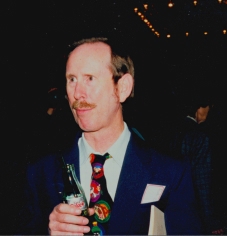
I’d never have made it as a professor….
Writing: Some Thoughts on How To
| Writing: Some Thoughts on How To Why add another to the endless list of books and articles on how to write? Especially since I am convinced that writing cannot be taught. I do believe, however, that it can be learned. So, here are a few things I’ve learned — maybe they’ll help you. No two people seem to do it quite the same way, yet the very beginning of the process, I believe, is much the same for all. Oddly for such a verbal process, it begins on the nonverbal level, with a mood, a yearning, an image. A vague desire to go somewhere or do something. When I’m in this place, I tend to re-read old books and stories with the same mood or yearning. Eventually I find myself putting together images, names, story ideas, backgrounds, and so on, a chaotic stew that gradually jells into a something I can call a story. Sometimes, of course, there’ll be a flash of lightning — an item on the news, an image seen, the putting together of two things — which will generate a story in one burst of inspiration. But these are rare. Don’t depend on them, unless you want to be a one-story-a-year writer. Open a folder on your computer for files of notes; get a box and throw cuttings into it; keep a notebook in your pocket or purse, and put it on your dresser at night. Every now and then, go through these hoards and add new thoughts to old notes — and throw away ideas you now see are worthless. Even once it’s jelled, my story is very sketchy. It may consist of a few notes, possibly (if I’m lucky) a catchy title, and a bunch of images and ideas too vague to write down. All I need now is a beginning (usually an image, hopefully an entire scene), and an ending. The latter doesn’t have to be complete, but before I start writing I must know the mood, the emotion I want the reader to carry away. Once I have the beginning and the end, and the mood, I’m ready to begin the first draft. The tone, which establishes the mood, must be set in the first scene. Sometimes the story hangs fire after I’ve written the first scene (even for months) before I can move on. I find, however, that if I don’t write at least a sketchy version of that first scene, I won’t be able to think about what follows. Sooner or later, the middle section of the story becomes fleshed out for me, and I finish the first draft. Surely, you think, there’s nothing here that can’t be taught. Didn’t Rob just teach me how to do it? —No, he didn’t. It may sound as if you now know all you need to at least begin, but it’s like learning to ride a bike. I “knew how” to do it, I understood all the instructions, but my reflexes had not learned, and could not learn from instruction. I’m fortunate in that I still remember many of the stages I went through in learning to write. At first, I consciously struggled with dialogue, characterization, motivation, plot. (I still struggle with plot.) I wrote, and wrote, and wrote, struggling along a rocky road. I was encouraged, however, by re-reading old stories. Stuff I’d written, as best I could, a year before now struck me as primitive. At length I discovered that I was no longer struggling consciously with dialogue, characterization, and motivation. I didn’t need to create a character with an elaborate cheat-sheet as I gather some do: age, education, favorite TV show, comfort food, and so on. I didn’t need to know these things, at least not consciously. I knew that I could create (or uncover) whatever about the character I needed to know, when I needed it. For me, learning to write was a matter of internalizing the process. I say again, I do not consciously work up characters (except to the most sketchy degree), motivation, dialogue, etc. When my characters walk onto stage and start talking, they seem real and alive in the first draft. This is what can’t be taught. You can learn it. You learn by doing it. —And here I tell people my only trick for writing: I become the character. I see what she sees, know only what she knows, think what she thinks. But I can’t teach you how to do this. I’ve internalized the process to such a degree that, though I’m the kind who plots, who has to know where the story’s going, I write very intuitively. It can be difficult for me to answer such simple and fundamental questions as: Why did she do that? What’s your story about? What does the waterfall symbolize? I can only shrug helplessly if asked, until I have thought about it. I may then know. But this is not to say that I don’t know what I’m writing about. I do know, on some deep level, well below the conscious. That seems to me to be the best way to write. Stories that start from conscious symbols or “what it’s about” come across as wooden or preachy. Just tell us a story. The meaning is in there; don’t belabor it. When I was eighteen, I burned hundreds of pages of MS, I’d guess a million words. All writers, we are told, must do this. All those bad things you write are a part of “training the reflexes” as in learning to ride a bike. You will burn them, but they are not wasted. Some writers outline even a short story thoroughly; some don’t even outline a novel. (There aren’t many of those.) My first published book’s outline consisted of a list of names of places where I meant to take my protagonist, scribbled on a 3 by 5 Rainbow Tablet page. But of course I knew what was going to happen to him (pretty much) in each of those places. That is, a lot more outlining went on than could be seen on the scribbled page. Also note that this book, WHEN THE CURTAIN FALLS, does not have a tight plot. It’s “discursive” or “picaresque”, meaning that it wanders. (cf. HUCKLEBERRY FINN.) Now let’s walk through the actual process, as I did it with one story: A Veteran of Foreign Wars (see the free fiction page here). The first notion was an idle reflection that in fantasy, when a man is changed into a mouse, or other animal, he is then changed back without harm. I thought: but the mouse brain doesn’t have enough storage space to contain the man’s personality. That would be lost; change him back, and you’d have a man with no memory. It occurred to me that if a soldier was changed into a mouse by enemy magicians, there’d be great reluctance to change him back until our magicians could restore his mind. I made a few notes on the subject in my “neat ideas” file, and turned my attention to other things. Months or, maybe, years later, I was going through the file and saw “the mouse story”. I could not remember what that was, so I opened it, and discovered that it was “A Veteran of Foreign Wars”, as I had mentally re-titled it, in the interim. I updated “A VFW” with the new title and added some thoughts. This pattern was repeated several times. Eventually I had accumulated the following: the veteran doesn’t know how to be a mouse — he has no memories of ever being a mouse. He is in the custody of his sister, his only surviving relative, who disposes of his pension and keeps him in a roomy cage. (Cheaper and more humane than hospitals for all these poor guys.) There is a youngish woman who claims to have been married to him and seeks custody of him — and her 10-year-old son, said to be the veteran’s son. This is an unstable situation and can collapse into a story any time — but what would bring about the collapse? This is the point at which I did actual serious thought about the story set-up, as opposed to the idle musings that had brought me this far. I needed an intrusion from outside, and with very little thought concluded that the Department of Veterans’ Affairs would naturally want to be sure that the vets are being cared for properly. An investigator for the Dept. could be the intrusion into the situation that might cause it to collapse. With that, I was ready to write the story. I already had the melancholy mood, the introductory scene, and the tragic conclusion, well in mind. See the list of free stories for results. It was published by Algis Budrys in TOMORROW in 1995, and on a convention panel A.J. gratified me enormously by praising it. Take note that this story violates one of the rules of effective short-story writing: Point Of View. In a short story, we’re told, there should only be one POV character, who sees and hears everything we see and hear, and whose thoughts are the only ones we’re privy to. But this story could not be told effectively from any one character’s POV; I use all of them except the vet’s. But you should not violate this rule without very good reason. Does it work for you? Would a unified POV work better? Whose? Only the mouse’s, I think, but he’d have to have enough memory and reasoning ability to explain what’s going on here. You’d either destroy the basis of the story — he could believably be changed back if he’s that smart and knowledgeable. Or you’d wind up with a voice-over narration, which would distance the reader — the narrator has no money on the table, no emotions about any of the characters. Okay, that’s a short story. How about a novel? Well, there, you need at least two stories (plot and subplot), and three would be better, all intertwined. That, for me, takes a great deal of conscious thought and planning, too much to go into here. Best advice for a beginner is to start with short pieces, from about 3,000 to about 20,000 words, and learn to write. Ten 10,000 word stories have the same word count as one 100,000 word novel, but they have ten times as many beginnings and endings, and writing them will teach you something about compression. Once you’ve learned to write, you can do anything you like. A dozen or so of my published stories are collaborations, but since each is a different animal, I can’t help you much if you mean to do one. L. Sprague de Camp, who collaborated with a number of writers, observed that the younger of a pair should probably do the first draft, because his/her writing is apt to be more vigorous, whereas the older one should do the second draft because his/her prose will probably be more polished. If you are at about the same level, no problem, go ahead and collaborate; I learned from all my collaborators even when our stories went nowhere. .Having said all the above, I feel defeated. Writing, real writing, happens in a place not reached by words. It can’t be taught. |
WRITING: SOME HINTS
FIRST, read a thousand books and stories. Never stop reading.
How To Start:
The seat of the pants method: apply the seat of your pants to the seat of a chair and start writing.
Robert A. Heinlein’s Three Plots:
| Boy meets girl. Little Tailor. One who learns better. Here’s an addition to Heinlein’s 3 plots: the gimmick story. [Biter bit, etc.] |
Heinlein’s Rules for Becoming a Writer:
| You must write. You must finish what you start. You must refrain from rewriting except to editorial order.* You must put it on the market You must keep it on the market till it sells. *Rule 3 is endlessly misunderstood to mean no rewriting. Not so. Heinlein is saying that when you have finished writing [Rule 2], including all rewrites, stop fiddling with it — send it out. |
Beginning the Short Story:
Chilson’s 3 rules for page 1:
- Grab the reader by the nose (use a punchy opening line)
- Shoot the sheriff on the first page (start the story at once)
- Put ground beneath the reader’s feet: who what when where (the “why” is usually your story)
[Henry Kuttner’s dictum: first get your man up a tree — then throw rocks at him.]
In a novel, the same three rules apply, but don’t have to be done on the first page.
Random Thoughts from Uncle Rob, for beginners:
1. Write the story — then cut off the beginning and the end
2. Cut everything by ten percent
3. Kill the ones you love (words & phrases & really neat stuff) (When you grow up, you don’t have to.)
4. Write as clearly as you can; that is style
5. Learn from everyone; imitate no one. (If you can’t manage that, imitate everyone.)
6. First, master the Craft; the Art will come
7. If your protagonist cries, your reader probably will not
How to create an alien
The problem with creating really alien aliens or worlds lies in the old country saying: “It ain’t what you don’t know that hurts you; it’s all them things you know that ain’t so.”
Larry Niven and Jerry Pournelle, in THE MOTE IN GOD’S EYE are a good example: two knowledgeable and thoughtful guys who worked out a detailed background. The “Moties”, we are told, are either right-handed or left-handed, and in right-handed Moties, the left side of the brain is bigger than the right.
Sounds reasonable, doesn’t it? That’s because of the unstated — and therefore unexamined — assumption. The reason that one side of our brains controls the other side of our bodies is because our spinal cord is given a half-twist; most of the nerves “decussate” or cross over to the other side in the medulla oblongata. Well, this is not a mechanical or electronic requirement; it’s merely an evolutionary quirk. There’s no reason to suppose — though it seems reasonable to us! — that this quirk would occur anywhere else. Niven and Pournelle were guilty of a thoughtless assumption — the bane of originality.
Well, it’s hard think outside the box when you don’t realize you’re in one.
But the real problem with the Moties is even deeper. Why would we assume that an alien brain would resemble a human one? Why two hemispheres with a vertical division? Why not a series of horizontal divisions, dividing the brain into flukes, like liver packed into a box?
The Velantians of Doc Smith (E. E. Smith, PhD.; the Lensmen series) had a brain like a stick with pairs of balls glued to it (in a head like a dragon with many eyes). Each of these lobes controlled one of a Velantian’s eyes and one of his/her many hands. Good for Doc, who examined his assumptions!
(Well, some of them. In story after story, Doc’s aliens of many shapes came in two sexes, male and female; and his female aliens acted an awful lot like human women as depicted by popular writers of the 20s. Hard to escape all assumptions.)
Throughout its history, Science Fiction has given us endless planets much like Earth in terms of gravity, air composition, temperature range, and biochemistry. On such worlds, it was assumed, we would require no special protective gear. We’d be able to breathe the air comfortably, eat the animals and plants, and so on. It was assumed that on these alien worlds, bugs would be small and that they would be hard-shelled and therefore jointed. Advanced life would be vertebrate, with spinal cords, and that the most advanced life would be warm-blooded.
Not one of these assumptions is warranted.
Can’t we even breathe air with the composition and temperature of Earth’s?
Maybe, but we cannot assume that we can. Because of another unexamined assumption: that on an Earth-like planet, the biochemistry will be very close to ours. DNA, RNA, and so on. We can’t make this assumption, though I think it likely, but even if we can, we still can’t guarantee breathable air. We assume that DNA/RNA based life would be compatible with ours, would in fact use the same 4 bases for its DNA, but why would it? We know of no reason why DNA could not have been built up from other purines and pyrimidines, like xanthine or adenosine, or why it had to have 4 bases. On the contrary, code experts will tell you that 2 bases are the minimum (as in binary code, on which computers run), up to — well, is there an upper limit? In any case, even if they use the same biochemistry as we do, they could still give us a nasty shock. Earthly DNA produces some deadly proteins, which unEarthly creatures might find tasty. Imagine walking into a room into which someone has sprayed aerosol rattlesnake venom. To the aliens, just pollen and other organic dust.
Bugs that aren’t small? Why not? Bugs on Earth once were huge, dragonflies as big as hawks (Meganeura), spiders as big as a person’s head (Mesothelae), giant centipedes (Arthropleura), and so on — but they all lived in the Carboniferous Epoch, 280 to 350 million years ago. At that time, the oxygen content of the air was half again what it is now. Because arthropods have passive breathing systems — even the arachnids, despite their “lungs” — they can’t get enough oxygen in our atmosphere to grow big. But why couldn’t alien bugs develop the very simple muscle-lung systems it would take to grow to human size? How big would we be, if our ancestors hadn’t developed muscle-powered lungs? Even mice need to breathe. (Here’s another step outside the box: our lungs work on a batch process — in, then back out. But our intestines work on a pass-through process. How would an animal differ if its lungs worked in such a manner, like a heart?)
Bugs that aren’t hard-shelled or jointed? Again, why not? Study the evolution of endo- and exo- skeletons for even an hour on the Internet, and you’ll begin to see how differently things might have gone. In any case, this is an assumption that should be examined. Once examined, this combined with the idea of large bugs, plus healthy doubts that only vertebrate life can be “advanced” will give you a truly alien alien: A giant bug with a tough leathery integument, an endoskeleton, lungs, and a nonhuman shaped brain. He might well look more like a scorpion than a man. (I’d name him “Fred”.)
Cold blooded? Well, here we’re on less firm ground. All chemical reactions speed up with increase in temperature; sugar dissolves faster in warm water, warm fruit is more tasty than chilled, etc. It’s true for all biochemical reactions too. But warming the entire organism is very inefficient. Small animals like mice and voles eat a sizable percentage of their body weight each day, just to keep the fires burning. Lizards, not so much. So, would it be possible to design a living creature whose nervous system and core muscles remained warm enough for rapid reactions if needed, but whose other organs might be much cooler? Difficult. Maybe possible. I suspect such a creature would be able, on frosty mornings, to jump, to sprint short distances, but if pursued, it would have to warm up. I’m thinking of mice gobbling bugs and small lizards too torpid to get away. On the alien planet, the pursuers would also have the same “efficient” build. Or maybe the arms race would end with all of them warm-blooded. (Really large animals are all effectively warm-blooded anyway, as they don’t have time to cool down overnight.)
In any case, the exercise is worth it, just for the practice in thinking outside the box.
Want more? On Earth, plant cell walls are made of cellulose, or polysaccharide — chains of a kind of glucose stuck together. One of the first “plastic” molecules, or polymers. Cellulose is made of carbon, hydrogen, and oxygen, and is therefore very cheap. Animals, on the other hand, don’t have cell walls as such. We have flexible cell membranes composed of proteins and lipids. —Might an alien plant have cell membranes of proteins? Why not? Imagine a plant that yields, not linen like the flax plant, but silk. Rotting “wood” on such a world might smell like a mildewed army blanket.
What was all that about a spinal cord? Well, chordates like ourselves are at a serious risk if the cord gets broken, or even pinched. How about a nervous system with two or three main trunks running parallel, and cross connected, like a ladder? Breaking one of the trunks would not be such a serious problem. The animal would have to learn how to route signals around the break, but it might well survive. Not so on Earth.
So, you’ve now had a lot of examples and you know basically what to do. How do you go about doing it? I don’t really know how I do it. Perhaps you should take a walk with a three- or four-year-old, and watch the child. You stride along the sidewalk, or the path, oblivious to practically everything. But she sees the dead beetle, and the little ants who are carrying away pieces of it. She sees the tiny spider in its small web, watching the ants. She sees the plastic wheel broken off some toy (black with a silvery “hub cap” painted on; the other side doesn’t look like a wheel at all, it’s just a sort of grid).
Normally you’d tug at her hand and say, “Come along, don’t dawdle,” or the like. Teaching her that such things are irrelevant, unimportant, to be ignored, not to be seen. Just as you were taught when young not to see. As with unimportant dead beetles by the sidewalk, so were you taught not to see the assumptions you grew up with. Learning to see them now will not be easy.
It’s hard to think outside a box you don’t know you’re in.
 Rob Chilson's Page