A Veteran of Foreign Wars
Yearning: Morning, Forenoon, Evening
5,000 words
June, 1995 Tomorrow
Alice Deshler grumbled more to herself than to the mouse. “Gotta git everything in tip-top shape, yessir, for that damn woman to see. Oh, don’t panic, Al, I’m just cleanin’ out your cage. I do it all the time.”
The small brown mouse cowered into a corner of its cage, away from Alice’s angry muttering and furious movements.
The Government-Issue cage was roomy and square, big enough for a family of mice. It had both round and square exercise wheels, ladders, automatic feeders and waterers, and a little house for the occupant to retire to. It even had a screened latrine corner with a cup below, which could be detached with a twist for emptying and cleaning, without opening the cage.
Al, the mouse, cowered amid this magnificence as Alice jerked out newspaper lining and scrubbed at the cage’s floor, making it rock on its stand.
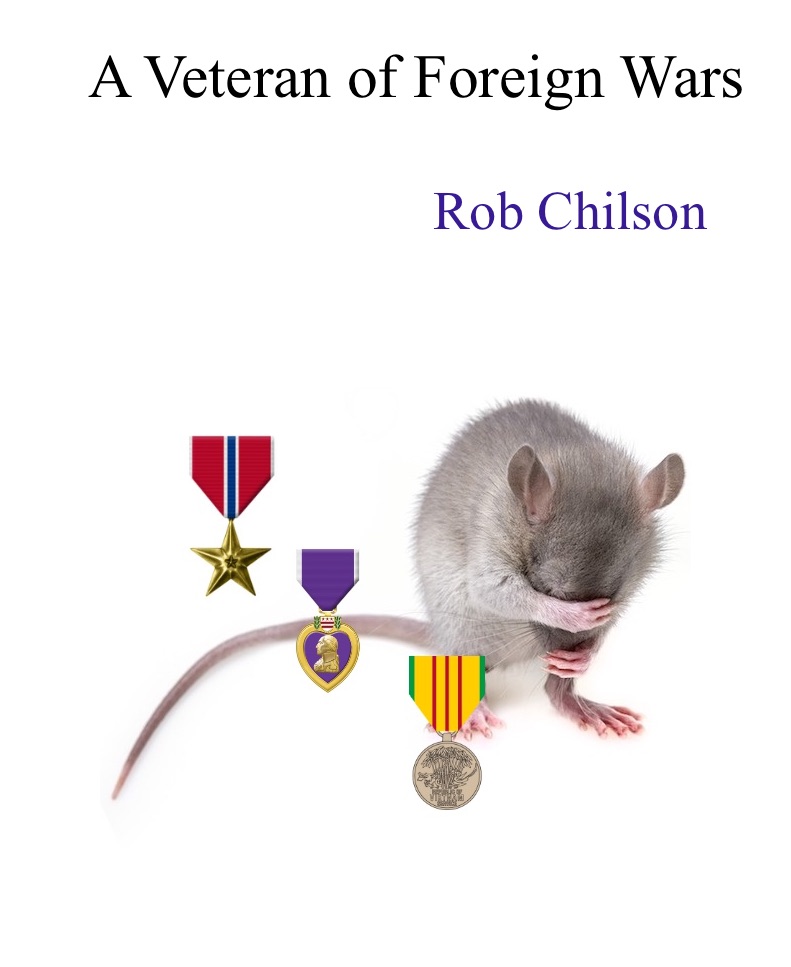
On the inside back wall of the cage, three medals were brazed, visible to the mouse and, through the wire, to viewers in front of the cage: above, the Vietnam Service Medal; below, the Bronze Star and the Purple Heart. The name of Algernon Edgerton was inscribed on them. His dog tags were tied beside them.
“Damn her, why can’t she stay away? She’s not gonna git custody and ever’body knows it,” Alice grumbled fiercely. “There! It’s as clean as she’d keep it, f’r damn sure.” She sighed. “Better make sure she ain’t got nothin’ to file a complaint about. Lemme git you some fresh food and water. Hmm. Maybe a piece of apple. How’d you like that, Al?”
But her tone was half-hearted. In years of caring for the mouse, Alice had never seen the slightest hint that it remembered — anything. The man from the Army had explained it to her.
“You see, Mrs. Deshler, a man has a bigger brain than a mouse. He can be cut down to anything with a smaller brain, though of course he won’t have the instincts that the lesser animal has. So the man cannot survive as a mouse; he doesn’t know how. Transformed men lose all except maybe a scrap or two of their memories, which in a way is a kindness. They don’t really remember having been men. But it’s doubtful if he remembers you, or even his own name, and most likely he never will.”
“But can’t you change him back into a man?” she had asked. “I mean, if them damn Vietcong sorcerers could change a man into a mouse, why can’t a good American sorcerer change him back?”
“Because the memories aren’t there,” he had said gently. “That’s the terrible thing about this kind of war. I only wish science had never discovered the transformation spells, as useful as they have been. A mouse’s brain simply does not have room for all the memories of a man. So if we tried to change him back, all we would get would be a man with no mind and no memories. A giant baby. He wouldn’t be your brother Al, any more than this mouse is — less. The VA and Walter Reed are still experimenting, but no answer has yet been found.” He had looked at her seriously. “We have no realistic hope that one will ever be found.”
And so Alice had cared for her brother the mouse ever since.
Not long after she finished with the cage, Alice frowned at the sight of a battered Chevy carpet swooping up the drive. Its fringe was tattered, hanging below the battered bumper, and it flew low, barely clearing the bumps in the flyway.
“One day that carpet is gonna fray apart and let the demon loose, right in mid-flight, and she’ll go smash,” Alice said aloud with bitter satisfaction. She stopped superstitiously short of expressing approval of the image, clamping her mouth
The Chevy eased to a stop and settled onto a grassy spot in the yard. Hounds bayed and the dogs approached, their tongues lolling in the heat, their tails wagging so vigorously their whole bodies bent and rebent. The woman in the car dropped the wand into neutral, putting the demon to sleep, and locked it from force of habit. The plywood doors opened on both sides of the coach body on the carpet, and she and a skinny ten-year-old boy got out.
Alice moved to the front door, looked out through the screen. “Afternoon,” she said, shortly. The hounds had fallen silent and were cringing around the ankles of the newcomers.
“Afternoon,” said Sylvia Lehigh. In contrast to Alice, she was still fairly slender except for a big behind, but latterly had put on enough weight to require a bra. Her hair was brown-blonde, darker at the roots, and her lips too red. Despite her youthful clothing, hairstyle, walk, and make-up, the harsh beginning of middle age was visible on her face.
Sylvia strode sturdily across the yard, across the patches of weedy grass, the bare patches of dirt near the unkempt, towering lilacs, past the long-unpruned roses, stepped over a dry branch fallen from the maple. The boy followed her with visible reluctance, but without lagging behind.
Without pause, Sylvia mounted to the porch, and Alice pushed the screen door at her. “Git on in there, Benny, and don’t let the flies in,” Sylvia said, holding the screen. The boy preceded her, stepped past Alice, and stopped immediately. His gaze went at once to the mouse’s cage.
Alice gentled the screen door shut and turned. At one time she had tried to fight off Sylvia’s visits, but the younger woman had become loud and abusive everywhere she went. Alice had thought it over, and concluded that the less said in public, the better. So she tolerated the visits.
“Go on and say hello to your daddy, Benny, honey,” Sylvia said with cloying sweetness.
The boy looked around in mute appeal. He was tow-headed, with a cowlick and a rooster-tail. He had crooked teeth and large blue eyes, and was so skinny his head seemed too big for his neck. Alice despised him.
“Go on.” Sylvia pushed at his shoulder. He moved slowly toward the cage.
#
Benny hated these visits. Under the admonitory shove from his mother, he walked slowly toward the cage. Its floor was only a little below his eye level. The strong, musky odor of mouse flooded his nostrils as he approached it. The mouse was nowhere to be seen. He smelled warm water and soap, and apple. Though he was always hungry, the smell of the apple with the other odors made him feel a little sick.
Then he saw Al, the mouse, cowering behind the little house.
“Say hello to your daddy,” came his mother’s impatient voice.
Benny looked at the mouse, and the mouse looked at him. Close up, it wasn’t an ordinary mouse. Its eyes were not black shoe buttons. They looked almost human, dark blue with small black pupils. The fur was longer on the head, and tinged with red. There were no whiskers; instead, there was a fringe of reddish chin beard such as no mouse had. The front paws looked like tiny pink hands, but Benny didn’t know if that was normal for mice or not.
Hearing his mother move impatiently behind him, he said, in a cracked voice, “Hi, dad.”
The mouse ducked against the little house, turning its head away till only one eye was revealed, peering back at him. A real mouse would either have run and hid, Benny knew, or would have become curious and crept sniffing toward him. But this was all that was left of Al Edgerton, they said. Benny had no doubt of it. They’d found this little thing shivering, like that, in the middle of a pile of clothes and weapons and Al Edgerton’s dog tags. Two days, or was it three, before they’d been able to come back to the field and recover the changelings? The mouse was lucky to be alive.
His mother came up behind him and Benny cringed a little from the emotions she pushed at him.
“Ten years ago now it’s been, since we was married and you was born, Benny,” she said. “It seems like yestiddee. I can still see him in his uniform, tellin’ how he was goin’ to go over there and kick them gooks’ asses. Cootchy-coo!” she said suddenly, with surprising gentleness, thrusting a work-worn finger through the mesh. “There-there, Al. I always loved you the best.”
Benny turned his head away, flushing and wriggling with embarrassment. Then his mother turned to speak to Aunt Alice, and, ignoring their grown-up conversation, he looked back at the mouse. It still cowered, peering at him with one human eye.
He wondered how it felt to be a mouse, but not a mouse. He wondered how it felt to live always in a cage. He wondered how it felt to be cared for by Aunt Alice. He wondered how the mouse felt about his visits, and Mommy’s.
He wondered if the mouse could remember anything, anything at all, about being a man. He wondered if the mouse knew who he was. If the mouse knew he was its son.
There was no connection in Benny’s mind between this not-mouse and the few pictures Mommy had of his father, Al, the tall lanky man in the faded jeans, with the reddish hair and mustache. She had none of him in his uniform.
He wondered if this mouse really was his father.
Shivering, it looked back at him.
#
Sylvia pulled her finger out of the damn mouse’s cage. It was always a relief when she had gotten the mouse-petting over with. She gave a last greedy look at it — it seemed as healthy as it ever did — and turned to Alice. Arms folded, the older woman stood regarding her with deep suspicion, square and blocky in a yellow dress that looked like the ones Sylvia’s mother used to make out of feed sacks.
“Have you heard?” Sylvia asked. “There’s a man in Osceola.”
“Nice for you,” Alice said evenly.
Sylvia flushed. “I mean, an investigator. A man from the VA.”
They looked at each other, then at the mouse.
“Well,” said Alice defensively, after a moment, “he’ll find nothing to complain about here. I keep the cage clean ‘n’ always put out food and water. If I’m out of the house, I have Si Longford stop in to check on ‘im, and I won’t have a cat about the place.”
“You never know about those guys,” said Sylvia darkly, just to make Alice sweat. “He c’d take Al away ‘n’ put ‘im in a institootion.”
Alice flushed. “He gits lots better treatment here than he would in a ole institootion.”
“Mort at the garage says his name is Jonathon Moulton. He awready raised hell with the Wittichs about their vet, Hank the cat. They wasn’t puttin’ down fresh food ‘n’ water ever’ day, Mort says. Sometimes the food would git moldy.”
They both looked at the cage again, even Sylvia feeling a little anxiety.
“Well, he’s got no complaint here,” Alice said again. “Did he take Hank away?”
“No, but he threatened to, Mort says.”
They contemplated each other in silent dislike for some moments. Sylvia was pleased to see that the worm of worry was gnawing at Alice, despite her care of the mouse. Who knew what the VA man would find to complain about? Why, there were books full of rules. Sylvia wondered how long it had been since Alice had read her handbook. A long time, she’d bet.
“Mebbe you better go through your handbook again, just to be on the safe side,” she said, and was delighted to see Alice’s half-concealed start. I bet she just remembered lots of things she’s been slacking, Sylvia thought.
“Well, we better go ‘n’ let you git to your work. I expect you got lots to do before that Mr. Moulton gits to you. Did ‘e call and make a ‘nappointment?”
Alice shook her head but said nothing. Sylvia smiled brightly, grabbed Benny, and dragged him out, with a final, pleased, goodbye.
“C’mon, Benny, don’t lallygag about.” She led her son out to the old car and fussed him into the seat. As she raised the wand, Sylvia had a thought. May be she should call on this Mr. Moulton.
#
Jonathon Moulton was not pleased to see the red light blinking on the phone when he got back to the little town’s ancient, cheap hotel. He’d had a hot and tiring day, and as he knew no one in Osceola, it could only be, disagreeably, about his work. With a sigh he punched the button and spoke his room number.
“Oh, yeah, Mr. Moulton.” He could almost hear the identification: the VA man. “You got a call from a woman named Miz Lehigh, she says for you to call her. Wait a minnit, I’ll git the number.”
Moulton wrote it down, sighed again, and called it.
“Mister Moulton, lissen, I gotta talk to you about my husband. My husband Al Edgerton,” came the rapid, high-pitched voice. “I gotta talk to you before you investigate him.”
“Hold on a moment,” he said, suppressing another sigh
“Perhaps you’d better talk to me in person,” he said. “How about tomorrow?”
She had to work, so they made it in the hotel lobby at five thirty. He decided to cut it short and call on Mrs. Deshler immediately afterward, so he called her and set up an appointment for six thirty.
Goddam, he thought. Custody battles. Just once I’d like to meet people who want custody of the vet more than of the pension. I need a drink.
#
Alice Deshler was nervous and fidgety for an hour or more before the VA man was due to arrive. She’d spent a good part of the day scurrying around, dabbing at dust here and there, having given the place a good cleaning last night and this morning. Finally the government carpet came swooping up the drive.
“What’s this?” she asked, peering out past the cheap magic-made lace curtain. “That woman and her son—!”
Three people got out of the polished wooden cab of the government car. Speechless, Alice watched them come, the tall, thin government man ominous in a gray felt hat, the damn boy as gangly and spindly as ever, Sylvia swinging her big hips in her tight red waitress-skirt and smiling like a snake in the grass. She’s pulled something, Alice thought instantly. She’s going to try to git custody—
Reluctantly Alice opened the door, introduced herself.
“Jonathon Moulton,” said the government man, gripping her hand firmly, looking her in the eye. Good looking despite glasses, early thirties, thin face. Good thing I put my hair up last night, she thought.
“Ah, I see him,” said Moulton, and went straight to the cage.
Well, it was what she expected. She watched anxiously as he inspected the cage, even going so far as to scratch at the wires, leaving a shiny spot. It occurred to her that if she’d been neglectful, and had recently scrubbed and scoured years of neglect away, there’d be no patina on the wires. Than God she’d done right by Al, she thought as he wrote on his clipboard.
Sylvia was watching anxiously as well, but smiled sweetly back when Alice glanced at her. You little minx, Alice thought viciously, smiling nervously.
Next the government man looked hard at Al, wrote more, and opened the cage door. Alice gasped at the casual way he reached inside and grabbed the terrified not-quite-mouse.
“Hmm,” said the government man, peering into Al’s eyes and feeling of his ribs and legs.
He put the mouse down and Al bolted, terrified, into his little house. The government man wrote some more, and turned from the cage, carefully latching its door. He looked briefly around the neat living room, nodded, and wrote again.
“All seems in order, in terms of the veteran’s care,” he said. “Your brother is well-fed, and seems healthy. His cage is clean, and it’s in a clean, neat, sunny room. Also, it’s not stuck off in an attic; it’s here in the living room. In short, my report will be very favorable, Mrs. Deshler.”
Alice sighed in relief, nodded, glanced at Sylvia. The younger woman looked brightly back, but smiled secretly. Moulton indicated couches and a chair grouped around her coffee table. Alice seated herself reluctantly.
“Now,” he said. “Ms. Lehigh has made certain claims amounting to a demand for custody of Al Edgerton.” He held up a hand as she started to speak. “I warn you both that I am not empowered to make that determination. Custody battles are not the business of the Administration; they should be settled in court.”
Alice looked quickly at Sylvia, who frowned; she knew the younger woman had no money for that.
“However, I will hear arguments on both sides, take notes, and if I think she has warrant for her claims, I can bring them to the attention of the Regional Director. He may or may not order a field investigation. Beyond that I can do nothing. However, I am willing to hear your claims.”
He looked at Sylvia, who smiled brightly back at him.
“Well, Mr. Moulton,” she began. “It’s like I said. Al is my husband. We was married by Revrin David Davis in the Full Gospel Assembly Church out to Sikes Ford on county highway K.”
This all came out as one glib blurt, and Alice observed that the government man didn’t write it down. He prob’ly had it wrote down already.
“She ain’t got no marriage license nor nothin’,” Alice broke in.
“Because I was so took by surprise, and Al was goin’ off to the Army so soon,” Sylvia shot back. “He proposed to me while we was at prayer meetin’, and we went up and Revrin Davis married us right then ‘n’ there. We was goin’ to git the paperwork done nex’ day, but we didn’t, on account we didn’t have time to before he had to go. But we was married reg’lar, in the church, which is more’n you were, Mrs. Deshler.”
Alice flushed but couldn’t resist the bait: “Gittin’ married by justice is just as good as by a preacher. Anyways, if you was married in the church, how come you ain’t got no witnesses?”
“‘Cause Revrin Davis died later that year from Complications of the Bowels, just b’fore Benny was born, and Benny was born nine months after Al went into the Army, weren’t you, Benny, an’ — Benny?”
They looked around. The boy wasn’t in the room. Alice dredged up a memory of hearing the kitchen screen door close — at least the little brat didn’t slam screen doors. “Gone out to the outhouse,” she said briefly and returned to the attack. “How come you can’t find anyone else who remembers you bein’ married?” she demanded. “Wasn’t there anybody else at that prayer meetin’?”
“Because the Full Gospel Assembly Church broke up after Revrin Davis died, and the congergation scattered,” Sylvia snapped. “Besides, I was so happy and so shook up and surprised, I didn’t notice who was there. Anyways, if I wasn’t Al’s wife, who was? Who was he goin’ with just before he went into the Army?”
“He could’a had all kinds of better wimmin than you,” Alice said viciously, but recalling herself, she glanced quickly at the government man.
He looked unhappy.
#
Benny stood looking at the little house where Al-the-mouse was hiding, preferring that to sitting on the edge of the grown-up quarrel.
The government man had impressed him. He had looked carefully at everything, and he’d been very fair. Benny had a low opinion of Aunt Alice’s care for the mouse, because of his mother’s constant harping on it. But Mr. Moulton was right; the mouse was well cared for, if not loved.
Behind him, they were going at it again. He’d been hearing such quarrels all his life. Wearily he thought: they don’t care about the mouse.
It wasn’t just the pension money, either. Mommy didn’t have a husband, though she’d had men living with them from time to time. But if she had the mouse, she could say to everyone: Here’s my poor husband.
And Aunt Alice. After Uncle Jim left her, she’d been alone, except that she had the mouse. She could say, I’m taking care of my dear brother Al, so I don’t have time to go looking for a husband.
He wondered if the mouse really was his father. He wondered what it would have been like, to have a father. He wondered what Al Edgerton would have been like, if he had not been turned into the mouse. What kind of a father he would have been. The kids at school wouldn’t despise him if he had a real father instead of just a mouse. They wouldn’t call him “Mouseboy” or just plain “Mouse.”
Behind them they were arguing. Not over Al Edgerton. Over a mouse they both despised.
Mr. Moulton had handled the mouse deftly, gently, looked at him with more interest, more care, than Benny had ever known either woman to do. He cares more for him than they do, Benny thought. Him and me’s the only ones that really feel sorry for him.
The poor mouse. Locked in a cage all the time, terrified whenever Aunt Alice cleaned it or fed him, constantly being showed to visitors. Cowering in the corner knowing somehow it wasn’t supposed to be like this, but not being able to make the connection. Just knowing that this was all wrong, wrong and frightening, fearful every minute of every day. Panting with fear even when asleep.
Benny looked through the tiny door, just making out the curve of the mouse’s back. Most of all, it yearned to be free, he thought, to be free of Al Edgerton, free to be a mouse. As he himself had so often yearned to be free of all this, his mother, Aunt Alice, being “Mouseboy.”
He opened the cage door quietly and reached in, gently, deftly, like Mr. Moulton had done, felt inside the little house.
The mouse didn’t bite.
#
Jonathon Moulton was eating a greasy Midwestern breakfast at the little hotel next morning when the waitress came to him. “You got a phone call, Mr. Moulton. From a Miz Deshler. Says it’s important.”
With a sigh he interrupted his meal and went to the old-fashioned phone booth in the dank little lobby.
“Mr. Moulton, something turrble’s happened,” came the frantic whining voice. “Al’s gone!”
After a moment he connected. “Gone! The cage is empty — you checked? Then — when did you see him last?”
“Last night — when you was here. I changed his water, but I didn’t see him — figgered he was still in his little house. But this morning I looked, an’ he was gone!”
He hesitated a moment. “I’ll be right out,” he said. Damn!
He got out his notebook and looked up Sylvia Lehigh’s number. He kept the call brief, told her nothing, but demanded that she meet him at Deshler’s house. She agreed, sounding scared. If she’s taken the mouse, he thought, hanging up the wand, I’ll have her arrested. The mouse had civil rights as a human being. The Changeling Law read, “shall retain all such civil rights as the Changed individual is capable of exercising.” This wasn’t stealing a mouse; it was the legal equivalent of kidnapping a man.
Fuming, he called up his morning’s appointments and postponed them all, and decided not to finish his breakfast.
The Lehigh woman and her son, both looking scared, were waiting in their shabby carpet when he arrived at the Deshler home. The heavy-bodied Deshler woman was glaring at them from behind her screen door. He deduced that the Lehigh woman had asked what had happened, and the Deshler woman hadn’t been able to resist charging her with the crime. They got out reluctantly as he came up. Moulton said perfunctorily, “Good morning,” and led them up onto the porch.
“Good morning,” he said briefly to the Deshler woman.
“Good morning,” she said viciously, glaring at the Lehighs but not speaking to them.
Moulton went immediately to the cage but without hope. Empty, of course. Nothing that would give a clue. He turned to the women.
They stood side by side despite their antagonism, regarding him fearfully. They had begun to realize dimly that what had happened was a mutual disaster, he thought. Nothing would ever be the same for them.
He didn’t know who was guilty, he’d realized. It was possible that the Deshler woman had decided to end her rival’s claims by accusing her of kidnapping the mouse.
“One of you,” he said abruptly, “is either very very careless, or guilty of a Federal crime.” They looked at each other, and behind the fear he thought he detected a flicker of pleasure on both faces. Concealing his puzzlement, Moulton continued: “Al Edgerton is missing from his cage. But he is somewhere. If he is found today, I’ll take no official notice. If he isn’t, I’ll have to report him missing to the Veteran’s Administration. That will immediately stop his pension, and it will alert the Criminal Investigation Corps, which will investigate the case under the Crimes Against Changed Veterans Act.”
He looked at them, and read only fear in their expressions.
“Now, I know you both have claims on the mouse’s custody. It may be that one of you thought it would be cute to frame the other for a crime against him, or at least a charge of carelessness. If so, and if the mouse is unharmed, I won’t report it as a crime, if the mouse is returned immediately. If not, I’ll have no choice.”
He looked at them. They looked at him, then suspiciously at each other. Obviously both knew the truth, obviously both accused or would pretend to accuse the other.
“I never even went near the cage yestiddee,” the Lehigh woman began in a high, brittle voice.
“Well, I didn’t have nothing to gain by taking him,” the Deshler woman said illogically. “I awready had him.”
Moulton raised a hand, weary already. “Look, I’m not here to accuse or assess blame. I just want the mouse back. If he is delivered to me at my hotel before sundown, I’ll ask no questions and take no action. I don’t intend to get involved in an argument; I don’t care who has him. I just—”
“I took him!”
A squeaky voice from behind him. Moulton turned, dread a cold weight in his belly.
The little boy, the mouse’s supposed son. After a moment the name came to him.
“Benny,” he said gently. “You took him? When? How?”
The watery blue eyes were more watery than ever; the whiny voice had a quaver. But the gangling, spindly, unhappy boy stood firmly and faced him. “Yestiddee, when you was all arguin’ about him. I took him out of his cage, and I took him out back, and I let him go free.” The last, proudly.
Free, Moulton thought in horror. He glanced at his watch; eighteen and more hours ago.
“You little shit!” the Lehigh woman screeched suddenly, lunging for her son. “You’ve ruint ever’thing, you little—”
Moulton extended his arm automatically, still dazed by the disaster, and brushed her back.
“He’s your son, you fool!” the Deshler woman said in hoarse triumph. “It’s you that’s ruined ever’thing.”
Moulton was not listening to them, but he waved them to silence so he could hear the boy.
“You let him go,” he said gently, kneeling to bring his face on a level.
“Yes sir,” said the boy firmly, despite the quaver. He was standing in a pitiful imitation of attention, straight, his hands down at his side, head erect on the spindly neck. A tear slid down his cheek, but he faced Moulton without quailing.
“He was all the time in that cage, and he was afraid all the time,” the boy said, the quaver becoming more pronounced. The words came out in a rush. “Ever’body was all the time fightin’ over him, and he didn’t know why he was there or nothin’ and he was unhappy. He wanted to be free!”
Moulton looked at him, and looked at the image of the mouse as seen by the boy. It was, he thought, still stunned, a happier one than the truth. For in truth the not-mouse had been incurably afraid, in a world it couldn’t understand, and hadn’t the instincts to live in. Whatever dim memories it had of being a man, it lacked the intelligence to understand them, so even its memories were a source of fear. Fear, in fact, had been its only emotion, fear of light and dark, feeding and cage-cleaning, of the women who came and poked at it, of the huge beings that from time to time gathered around and looked at it. Perhaps the boy had been more merciful than the government.
Free at last, he thought.
“I give him twenty-four hours, no more,” Moulton said. And eighteen of them had gone.
He shook his head. Out there in the unkempt grass of the fields, among the mouse runs and burrows, or under the old house, all that was left of Al Edgerton was probably already dead. For in the subtle, intricate society of mice the little pseudo-mouse had no instincts to guide him and insufficient intelligence to take its place. And so he must have crouched and shivered his last hours of freedom more illusion than real even for genuine mice. For him, freedom was a disaster as awesome as a bolt of lightning upon his cage.
Of that terrorized and pitiful end of a man, the women had no conception, and no remorse. They were quarreling behind him in bitter, venomous voices, each blaming the other for the death of a mouse.
Then Moulton’s gaze met that of the boy. The boy’s wide eyes were fixed on him, brimming with tears.
There was the one creature, he thought, who mourned the man more than the mouse.
He reached out, touched the thin bony shoulder. “You did right, son,” he said. “It was time we let him go.”
– end –
The Dragon’s Egg
Here’s an old story, one of my earliest, never published. According to my opus card, I wrote it in February, 1971, and apparently never attempted to sell it. I tweaked it in 1995, re-working and workshopping it with my writers’ group through what I called my 4th draft. Submitted it to 3 magazines in the next two years, no sale. It’s a minor story, but not a bad one, and I found it interesting to compare with my later work.
6,400 words
Bryan of Clough saw the plume of smoke the moment he stepped out of the woods into the road. It towered against the darkening sky to the southeast, its top still catching the rays of the sinking sun.
Even then, he knew.
Bryan quickened his pace, hurrying along the well-known way through the narrow valley of the Clough. It was fully dark when he came to the smoldering remains of his cottage and barns. Only the coals still lived.
Why? was loud within him.
Taking a stick from the woodpile, he lit it at the house, and looked. Hoofmarks and the imprints of nailed boots. The boots of men-at-arms. Bones, many with flesh still on them; his cattle, slain and roasted over the coals of the great oak that had shaded the thatched roof. The fowl were scattered into the forest, prey to hawk and owl and fox.
The land alone remained.
His mother was not here, nor did he see a grave.
Following the tracks, Bryan saw that the troop had come up from the south, apparently having crossed the river Twy at the Stone Bridge. He had seen no smoke to the southeast, so they had not burned the village of Stone Bridge. They had returned the same way. A scouting party, attempting secrecy, he judged.
Except that they had burnt this one cottage and barns. A wanton act? Or had the men-at-arms been led here by some more personal enemy?
Bryan thought he could name that man — Leonel, Bryan’s rival for the hand, or at least the body, of Maken. Bryan reached into his pouch and reflexively gripped his favorite sling stone, his dragon’s egg. He’d seen Leonel that very morning, in the steel cap and chain-mail shirt, and carrying the short axe, of his new trade. It was in the market at Michaeldeane, where amid the lowing of the cattle and the bleating of the sheep his and Maken’s forthcoming nuptials had been announced.
Bryan had been standing by the crockery booth when he heard the fuller say, “By the Evil One, it’s Leonel. The tosspot’s taken arms.”
He looked across the happy, holiday-dressed throng and saw his unsuccessful rival speaking to Maken. Leonel’s sardonic gaze locked on his. A faint ironic smile quirked the thin lips under the thin black mustache.
Bryan of Clough looked grimly back, standing like a rock. His toil-toughed, oak-root arms hung in careless consciousness of strength.
Leonel quirked his mouth again and glanced idly back to Maken.
Bryan looked at her also. Maken had been flushed with pleasure all morning. Her new dress of fine russet wool and their wedding agreement made that day before the manorial court, had made her the center of attention. Her eyes sparkled as she looked up at Leonel.
“He’s taken arms with the Lashmars of Craydon, it would seem,” the blacksmith added. “That head-piece was made in Craydon, any road.”
The Lashmars were the ancient enemies of Leonel’s father’s patrons, the Knolles family of Loch Lorrough.
“What, he’s turned traitor to his father and his father’s people?” asked the miller’s son. “What will old Sir Giles say?”
“But who would tell the poor old sir his second son’s a worthless wastrel, and break his staunch heart?” asked the smith.
“The sooner he takes himself off to the war and gets his death, the better,” muttered the miller’s son.
“If only Alwin would return!” said the fuller.
Leonel’s older brother had gone off to Court.
At length Leonel had left the market square, with a farewell wave to all. That, Bryan thought grimly, standing over his smoldering ruins, had been at mid-morning. Time and more than time for him to have met that troop coming up from Stone Bridge and to have led it here.
Bryan made his way numbly through the night to Combe Brook, a tiny hamlet huddled within doors. Eovan Mason, his uncle by marriage, peered out at his knock, his face haggard with grief.
“Thy mother is within, lad.”
Her poor eyes were wholly blind at last. She had been laid out, he saw, in the dress she had intended to wear, if able to be at his wedding. Her sister the mason’s wife was still trimming it — the bottom was as yet unhemmed, he remembered inconsequentially.
He was ten years older when he looked up, and his heart was stone. “Tell me.”
Eovan hesitated. “The men of Craydon, it was. They came in the middle of the afternoon, from up south-away, a score of men behind two horsemen. The knight seemed regretful, and had your mother carried here. They harmed no one and nothing in Combe Brook.”
“Who murdered my mother?”
“None, Bryan, so they urgently said, and there is no wound on her — my wife washed her. When the men would have eaten your livestock, she caught up the axe and dared them fall on. No villein she, despite her age and blindness and sex! But she fell dead in the struggle as they sought to disarm her, so the knight told us.”
Bryan looked at the cluttered pots and pans on the wall, dim in the dancing light of the hearth, picturing his mother’s last defense of him and his.
“They burned the buildings belike as a warning to all of Combe Brook. But the knight did seem very kind.”
The cold part of Bryan’s mind rejected that. They burned the buildings and slaughtered the livestock wantonly, knowing the war would excuse them. Certainly the knight regretted that burning; the pillar of smoke had carried word of the foray far faster than peasants running across the fields.
Unless Leonel was of the company. Then it was no wanton act, but a malicious one.
“Did you know any of them?”
His uncle’s eyes widened. “Nay, lad, we scarce could take it in. Any road, we hid within-doors, lest our gaze offend them.”
His great-uncle looked beseechingly at him. Bryan forced himself to be human. “You did well. I thank you and my aunt for your service to my mother.”
The mason’s wife was aged by grief, her gray face strained. She lit wastefully many candles and urged him to sit down to bread and cheese.
Bryan could not eat, and had no stomach for the long, hushed discussion they and the neighbors wanted. Instead he went up to the bed they offered him.
When he closed his eyes, the day came back in torment. Morning seemed so long ago, now, that it was like last year to look back on. He saw again Maken smiling up at him, her bright brown eyes sparkling, her rich red-brown hair sheening like fine old wood. Bryan smiled back at her, unable to say how her beauty tugged at his heart.
“Have you heard?” she asked eagerly. “Leonel has taken up arms. It’s almost as if he had entered a monastery, is it not?”
Bryan smiled. Leonel wasn’t one to enter a monastery for loss of a woman. “No,” he said. “It’s easier to leave the monks than such knights as the Lashmars.”
Maken was startled. “The Lashmars? No, surely he’d not have taken service with the enemies of his father’s patrons. He spoke no word of it.”
“Would you expect him to?” said her father heavily. He was a dour franklin with three daughters and no sons. “Sir Hugh Lashmar has enough drunken men-at-arms under his banner without adding yon. But Leonel is not so well known to Craydon-way.”
“Goes Leonel as a common man-at-arms?” That seemed to shock Maken more than his treason.
“Why not?” Bryan looked toward the landless knight’s rented castle, Croughton, where it loomed above Michaeldeane. “Sir Giles has but the forked pennon of a knight bachelor. Leonel is but the second son of a poor knight of no family. He is no more a nobleman than I, or your father. He should have gone to court with Alwin, perhaps to return as a true knight.”
“No more nobleman than you?” Maken protested.
“True,” said her father. “Bryan is a franklin and a freeholder. Should he take up arms, he might well be knighted himself.”
“That was more common in olden days,” said Bryan, smiling.
“But possible, you are no serf,” said her father.
“But still they are nobles and we are not, and it is not our place to criticize,” Maken said.
“True,” said Bryan. “And if to serve in arms is necessary to be ennobled, then Leonel is more likely to win it than I.”
She would bitterly resent any attempt to destroy her innocent dreams of knights on white horses. Leonel represented romance to the simple girl in a way that he did not. Bryan, who had no such romantic side, did not love her the less for hers.
“He’d not have been forced to become a mere man-at-arms if his father had provided him with proper horse and armor!”
“He did,” her father answered. “Leonel drank and gambled them away long ago.” He gazed unseeingly at Croughton Castle. “I give thanks that I owed no money to Sir Giles, else, my daughter, you’d have had but small choice of husbands.”
Maken took a breath that strained at her bodice, confronting them defiantly.
Unwise, to thwart her so.
Bryan put his hand on the older man’s arm, smiled at her. “It was well of Leonel to make his farewells ere he marched off,” he said mildly. “But it is our own fortunes we celebrate today. I bear a heavy charge: to carry to my mother a most exact description of every dress here and the well-wishes of all her gossips.”
Maken smiled enchantingly, and his heart melted again. She dearly loved his old half-blind mother.
She took his sturdy arm. “A heavy burden indeed. Come round with me and I will help you.”
Bryan stared unseeingly into his midnight. All help was helpless at last, and his mother would never hear that blithe report.
#
On the morning, Bryan forced himself grimly to eat.
An officer and two Knolles squires rode into Combe Brook even as he was at table and began to question the vociferous folk. They viewed the body of his mother, baring their heads. Bryan stood grimly aside and volunteered nothing.
While the investigation continued he left his uncle with but a word of farewell, and strode purposefully to his land. In the yard he found the old axe whose use had cost his mother her life. No other tools survived, the rest having gone with the barn. He would need to build everything, everything, anew. The cold part of his mind began to estimate what to do and how to do it. And where the money would come from.
He’d have to borrow the money, pledging his farm. The Knolleses would have it in the end. And for him — and Maken — would only be left the life of a cottar, living on a rod of her father’s land if they were lucky, or the half of that, and doing whatever odd jobs they could find to keep body and soul together.
The hot part of his mind came to the surface. Leonel had brought them to this. He had known what he’d done.
In one hand, Bryan held the axe. With the other, he reached into his pouch and gripped his sling.
Then he remembered the words of Velaunus. He’d met the man on his way home from Michaeldeane. . . .
The other wore the cowled gray robe of the Seekers, those wanderers who ever sought for forgotten lore.
“Hail, fair sir,” he said. His cowl was back, and his hair was of a silvery paleness. “I hight Velaunus the Seeker, and at the moment I seek supper and bed. These may be had, I believe, at Micheldeane. Am I far from that place?”
Bryan smiled. “Bryan of Clough I am. Keep to this road and you can scarcely avoid Micheldeane if you would. Where from, and whither bound?”
“From Craydon, yesterday. To Loch Lorrough tomorrow.” Velaunus leaned on his staff, but did not look weary.
“What news of the war?” Bryan said. “We’ve heard naught later than day before yesterday.”
“Aye, the war. Prevention is not possible, or they’d not be men.” Defeat slumped Velaunus’s shoulders. “But say not that we didn’t try, lad. And now let the kingdom look to its head.”
“This is but a tilt betwixt neighbors,” said Bryan mildly. “A private war.”
“How private? All the kingdom might well be in arms when the harvest is in and the peasants can legally be called up.”
Bryan shrugged. “Let each look to his own head, say I. The war will weigh more heavily on the heads of the nobility whose quarrel began it, than even upon the heads of the peasants who must fight it.”
Velaunus smiled. “Ah, the peasant speaks. The fields remain though the houses be burned, and when the battle cries fade, will come the sound of patient men urging on fat-eyed oxen before unshod plows. Life goes ever on. Eh?”
“Even so, as it has always done.”
“Forever?”
The Seeker looked through and past Bryan, his pale hair seeming the white of an old, old man in the paling light. The lines of graven sadness around his eyes seemed that of an age no man should have to bear.
“Does never the old tale end?” he asked. “Surely mankind has enemies of terrible potency and terrible malignancy. Else, why this constant scourge of war?”
Bryan shrugged sturdy shoulders that had never known defeat, touching the ornate sling in his pouch. Its stroke was the strongest magic he knew or needed.
“If we have such terrible enemies, why do they not confront us directly? If they fear us so, can they be so terrible?”
“A good question. My Order has no sure answer, but there are suggestions that these great enemies are bound by natural laws. Even as the squirrels and deer are bound by the laws of their beings. Whereas — do you agree? — men are subject to no such limitations. In our way we are above Nature and subdue it to our will.”
Bryan nodded. He was a poacher among poachers, and knew animals. In his purse was his dragon’s egg sling stone, that he showed to none and of which he had spoken to no one. It was smooth with illegal use.
“There is much in what you say,” he said slowly. “Most men act unthinkingly, repeating yesterday today, and sleeping that they might repeat today tomorrow. Yet there are a few who cannot be predicted in the way animals can.”
“Yes,” said Velaunus. “Perhaps our enemies have good reason to fear us.”
Bryan shrugged, himself again. “Certainly, if they dare not face us in the flesh, we’ve little need to fear them. Those we do face deserve more thought. Speaking of them, what news?”
Velaunus laughed, but said, “The Lashmars did not take me into their councils, but their muster was not complete as of yestermorn. I look for them to march hereward tomorrow or next day at latest.”
Bryan nodded, thoughtful but unperturbed.
“You are not concerned?” the Seeker asked.
“Little,” Bryan said. “My freehold is in the Clough near Combe Brook, well off the main track. The wanderings of my cattle concern me more than the wanderings of armed men. If I hie off to war, who’ll care for my old mother, not to mention my stock?”
“You have never felt war, or even seen it. You would defend your land, should any soldiers come anigh?”
“Should soldiers come anigh, they’ll only be in search of food. The loss of my cattle and stored grain would be a blow, but the land will remain, as will I. Still, I am not unarmed.” He brought his sling from his pouch. “It’s now but a hunter’s weapon, though it has seen war in its day.”
Velaunus took the horn-shaped sling handle. “It fills the hand like an egg from my neighbor’s hen. But this bronze trigger is Eastern work, and this walnut stock is old. Surely it came back from the Great War?”
“No, sir Seeker, but that is hard by the mark,” said Bryan, pleased at this show of lore. “Only the trigger. The handle was already in my family at time of the Great War. It accompanied my ancestor, Wat o’Clough, who followed Amal Lightning. With part of his spoils of Cornedun, Wat had the old trigger replaced with the finest bronze work he could command in Aramya.”
“Has it been to war since?”
“A time or twain. Usually to the fair, however, where it usually won — enough to keep it in fine fettle.”
“Wonderful!” said the Seeker. He held it up, nodding in respect for the skill that could swing so long a sling. “Its history is the history of your own family. A family of greater lineage than the Royal family. Did it not accompany Amal? And where now is the blood and kin of Amal?”
Bryan smiled. “It’s the oldest member of our family.”
For a moment, he was tempted to demonstrate his skill. But there were no suitable stones in the road, and in his wallet he had only his dragon’s egg. Not even to the Seeker would he reveal that.
He had found this smoothly-rounded ovoid while he was digging his father’s grave, when he was eleven. From the first he had known that it came from his father. A smooth shell of hard stone around a mass of crystals, the frozen egg of a dragon. He had seen them broken, but never another whole one. He was careful to keep it away from fire, lest it hatch. . . .
It was still in his pouch. Standing above the still-smoldering ruins of his life, Bryan stood the axe carefully against a tree. The Seeker might believe in terrible and unseen enemies, but he knew who his enemy was. Bryan turned his face again toward Michaeldeane.
The sun was still not far above the horizon when he reached the dense forest. Here was the end of the path, where he’d stood when he first saw the smoke of his house, hidden before by the trees. Bryan looked back along the narrow valley of the Clough, and all looked the same. One look, and he entered the forest. The path was the familiar short way north over the hills between the Clough and the valley housing Michaeldeane and Croughton Castle. Presently he approached the road that led from Twyford to Michaeldeane.
A gleam caught his eye. Steel flickering between green leaves, where no steel should be. Bryan stopped, looking steadily toward it.
After a moment he left the path, treading with utmost care among the leaves of the forest floor. He made his steps irregular and used every scrap of cover, stalking a man as he had often stalked deer.
It was indeed a man-at-arms, standing in ambuscade behind an ash tree to watch the road. Bryan thought he could name the man. Who but Leonel among the Lashmar forces knew the land so well?
He wore a round steel cap and chain-mail shirt, and a short axe hung from his belt. No hair hung from beneath the edge of the cap, and Bryan frowned. Then he removed it and ran his fingers through long black hair, and Bryan nodded. Doubling his hair to make extra padding, the man-at-arms replaced his cap.
Deliberately Bryan brought forth his dragon’s egg. The frozen fire in its heart matched that in his. It was as eager as he for this cast. He stepped into the open to have room for the sling, and began to swing it. Two full revolutions it took, because of the long straps.
Something caught the attention of the man-at-arms. He turned boredly, and looked — had time to freeze in incredulity, mouth open in his thick black beard.
Beard! —but he had already loosed.
No! something in him cried, too late.
The sling licked out, snapped back like a serpent’s tongue. The dragon’s egg was a large dot suspended in mid-air above the unbelieving face of the stranger. It shrank with incredible rapidity and swept inevitably down to irrevocable union with that fear-frozen face.
Not Leonel! cried a part of Bryan, forever too late.
The dragon’s egg caught the stranger just below the rim of his steel cap with a whock! like the satisfying final blow of the splitting maul that lays the ten-foot oaken log in equal halves upon the ground. For a moment the slack face with its opened O of mouth hung, amid cap, dragon’s egg, upflung hand, and other things. Then all fell down.
Bryan ran forward to recover his stone, breathing as if he had just run up a hill. He looked at the man he’d slain, the first man he’d slain.
He was somewhat older than Bryan, black-haired and brown-eyed. He had the look of a town-man, but had also the look of an old dog of war. A landless man, who took the shilling to support his family, and spent most of his time boredly guarding castles and keeping the peace in market-squares. Married, no doubt, with three or four children.
Bryan had never known a man so well in life as in death he knew this one.
The dragon’s egg had taken him before the ear. There was red and gray and white matter all around. Bryan saw his stone lying innocently near the trunk of the ash tree, and reached for it.
It had waited long to kill a man.
Bryan straightened, dropping his hand to his side. Still he saw that pinched, bloodless countenance. What a fool he’d been, came a distant thought, to carry a firedrake’s frozen egg as a sling stone. Velaunus would have known better.
He left it lay.
Quickly Bryan stepped through the last line of trees onto the road, feeling that he was leaving part of himself behind. He could not tell if it was the stone, or the man he’d slain.
In the road he stood irresolutely. For first time since his father’s death, Bryan hesitated, unable to decide what to do. The dumb Presence behind him goaded him onward, but which way? West toward Michaeldeane and the lords’ muster and revenge? North across the forest and fields to Maken’s father’s house? Much would depend on the answer—
There came the dull metallic sound of shod hooves and the swelling murmur of marching men. Around the curve of the road came two men on horseback, then two more. Bryan recognized the Knolles arms, then the face of the baron, Sir Hugh Knolles, strange in his helmet. A man on foot carried a blue pennon with a square end; that of a knight banneret. Beside him strode the huge fellow called the Black Bull, the baron’s most loyal henchman, leading a dozen light-armed men. Behind them marched a column of heavy pike.
The horsemen pulled up and the pikemen leaned on their helves.
“Here’s a peasant in arms, Sir Alwin,” said Sir Hugh.
A strange knight urged his horse forward and looked at Bryan. “Nay, my lord baron, it’s Bryan o’Clough, who won the slinger’s prize at last High Day’s Fair,” he said. His features were vaguely familiar, Bryan thought, and his voice. “And he holds the self-same sling with which he won the prize. What are you doing here, my good man?”
“A Lashmar man-at-arms lies dead behind the ash,” Bryan told them. And then he recognized the strange knight: Leonel’s older brother Alwin, back from Court. Did he know his brother had betrayed the Knolles arms?
“Slain by your hand?” the baron said. “Well done! Take your place in the van, under the Black Bull — tuppence a day and found, when we can find it.” The men grinned; an old soldier’s joke. “Sir Alwin, what is a man of Lashmar doing so far into our lands?”
“Spying of course, my lord. Now I think me, there is a path through these woods along the ridge that takes one to Twyford more straightly than the road, which swings north to avoid the hills. No armed host could negotiate it quickly or quietly, however. It would be well to send the Black Bull’s best poachers — er, foresters by way of it. We may find the village and ford held against us.”
Sir Hugh Knolles looked at Bryan. “If this man’s tale is true. Or is he a spy himself?”
“No, all Micheldeane knows Bryan o’Clough.”
“Brother Velaunus?”
The young-old Seeker stepped forward, his gray robe dusty. “I met this man myself yesterday, and he then claimed to be Bryan of Clough. But why ask? Look behind the tree.”
“Well said.” The baron gestured and the Black Bull bellowed a couple of his men to the tree.
Velaunus looked at Bryan. “Why are you here?”
“By the Evil One!” cried one of the pikemen. “Dead’un here, sir! No arms.”
“The Lashmar men burned my house and killed my mother yesterday,” said Bryan tersely.
Sir Alwin said, “We saw the smoke. Join us, then, my good man. May your loot rebuild your house! He’s a freeholder, my lord.”
Sir Hugh nodded to the Black Bull.
“Alan!” bellowed the Black Bull. “A jerkin and cap, and an axe!”
“My condolences on the death of your mother,” said Velaunus quietly.
The nobles were receiving the report of the pikemen. “One deader, stove in by a sling stone. No arms, or favors of ‘legiance. No sign of anyone else around, a-tall.”
The nobles and the Black Bull drew aside and took counsel.
Velaunus said to Bryan, “Why are you here?”
Bryan looked at him in astonishment, donning the heavy leather jerkin. “To avenge my mother’s death, and my loss,” he said.
“Even so? Yet I wonder,” said Velaunus.
The baron rode back to them. “You men of the van shall follow Sir Alwin along this way he knows of, and many of you doubtless also know,” (they grinned) “and come at Twyford village from the back. The rest shall march along the road, and we’ll hope there are no more watchers. We can but hope there are Lashmars in Twyford; if not, we’ll meet them on the road, and the van shall follow up and fall on their rear.”
Sir Alwin dismounted and called them to follow. Bryan waved a farewell to Velaunus and fell in with the Black Bull’s men, many of whom he knew. The steel cap was heavy on his head; he had a feeling of being carried out into loud rushing waters.
#
Bryan and the Black Bull’s men stumbled along the obscure way through the forest, passing well north of Coombe Brooke. A couple of hours later they looked down from cover upon the fields about Twyford. The small village was a scene of confusion, with horsemen riding about and men rushing two and fro. Four ox-drawn wains were just crossing the ford.
“They must’ve taken the village last night,” Bryan heard the Black Bull say. “Lay here, and stopped all traffic, lest we hear of it. But their goods only now arrive. Old Sir Cedric must be fit to kill.”
“So small a place can have had but little aliment,” said Sir Alwin. “That they’ve eaten up, nor would they dare straggle to forage as they push onward in our lands. So they had to wait for their wains. Good. Better to fight them on the border.”
The Black Bull ordered them to cover, and threatened death to any whose peering gave the alarm. The men grinned and took off their steel caps. Most did not even watch the village, gathering on the back slope of the hill to roll knucklebones. Bryan sat aloof, feeling empty. At noon they ate, and shortly after someone called down to them.
“Sir Hugh and the pike are coming out of the defile!”
Bryan hurried to the top and saw that the Lashmars had been warned. They were still hurrying into position. Sir Hugh and his few mounted followers charged at once. The pike also charged even before its formation was complete, so urgent were they to keep the vantage of surprise.
Uproar arose, the Lashmar forces scrambling to meet the shock. Sir Hugh’s few mounted men crashed through them and sent them reeling, but they reformed to meet the pikemen. Pushed back to the houses, they held.
Then Sir Alwin stood up on the hill and blew the charge. Down came the Black Bull’s men, screaming and yelling and waving weapons. Archers and slingers paused to loose, and ran on.
Bryan ran grimly with them, not yelling, not pausing to cast until he was well within range. He’d filled his pouch with likely stones at a stream. The frozen part of him told him to try nothing fancy, to aim at bodies, to hurt, frighten, and harass rather than try to kill.
Dismayed by this force on their flank, not knowing how many men Sir Hugh had with him, the Lashmars broke back to the ford. Sir Hugh fell on them and turned their retreat into a rout.
“Come, to the ford!” cried Sir Alwin, leading them around the village.
Bryan scrambled over walls and ran through orchards with the Black Bull’s men, and they halted, winded, in range of the ford. Archers and slingers opened a light bombardment on the fleeing men, urging them on their way. Then Sir Hugh came down with a dozen of his men to seize the ford, and Sir Alwin led his men out again to take the defenders in flank.
All resistance broke, and the Lashmars abandoned their wains, splashed back across the river.
“Sir Alwin, take charge here, root me out the last of these rascals,” Sir Hugh cried. “I shall continue the chase.”
“Aye, Sir Hugh! Come, my men, back to the village.” Sir Alwin led them back among the thatched, half-timbered houses.
“Surrender!” the Black Bull roared. “We give quarter! Surrender!”
Sullenly the few Lashmar men who had not gotten away surrendered and were herded into a barn under the gaze of a half a dozen of the Black Bull’s veterans. Bryan was told off with half a dozen more to keep the local peasants off them, and feared for a time that his second slaying would be that of a crazed woman.
Sir Alwin counted noses. Of perhaps a hundred men who’d clashed at this village, but three had died, all Lashmars. Two of the Knolles men were badly wounded and one like to die, and four more of the Lashmars were in similar state. Sir Alwin visited all the injured, Knolles and Lashmar alike, and laid all in the same barn.
Then he had time to give attention to the tree by the river bank.
“Have they commenced the hanging of Sir Hugh’s peasants so soon?” he asked the Black Bull.
“Nay, Sir Alwin, it’s one of their own men-at-arms.”
“By the Evil One!” Bryan heard Sir Alwin cry. “It’s my own brother!”
Bryan had been relieved of guard duty and was resting, his mind still blank, but at that he rose and went down to the river. It was true, he saw, and something inside him moved.
Sir Alwin’s dark hawk face reflected some indescribable emotion. Turning to some of the peasants who dwelt there, he demanded, “Whose the hand did this deed?”
At first they were all too frightened to speak. Finally one, pushed forward, cleared his throat and said, “Please, my lord, it was the Lashmar lord, old Sir Cedric the Fat. Yesterday it was, in the middle of the afternoon. This wight — er, good sir, your brother, he, uh, was charged with drunkenness and ravishment — one of the dairymaids, sir — and of disrespect to the lord’s deputy. He fought with him, sir. Sir Cedric ordered him hanged as an example to the men.”
“Doubtless he knew nothing of his lineage,” said the Black Bull, looking at Alwin’s dark face.
Sir Alwin laughed bitterly. “Doubtless he knew quite well.”
“He but met the fate marked for him in the stars,” said the Black Bull. “And,” he added boldly, “a fate not unmerited by himself. You know but little of your younger brother — you’ve been away long—”
“Say not that his fate was marked in any stars; the stars are too high for such as he. I knew my brother well before I left Croughton Castle.”
Bryan looked upon the face of his old rival. It was not pleasant, but it did not move him. As nearly as he could calculate it, the man had had but an hour or so to do the deeds that condemned him after arriving in Twyford from his spying mission in Michaeldeane. He could not have been near Bryan’s cottage.
Even as he mounted the scaffold — a round rock — Leonel must have seen the smoke of Bryan’s cottage. Indeed, that smoke might well have been the death of him. Sir Cedric, knowing that his carefully concealed movement into the Knolles barony was betrayed by bunglers, would require but a trifle to shipwreck his temper.
“Cut him down,” said Sir Alwin. “Give him burial — I see a churchyard there; doubtless there’s a priest or friar about. Now, about these wains—”
Bryan helped to dig the grave, listened to grave words, and covered up Leonel. He felt like a man in a dream, moving unscathed amid terrible events. Leonel might have been a stranger. Far off, he knew he felt something. But he didn’t know what.
Bryan ate bread and sausage and cheese with the Black Bull’s men. Then he helped set up a camp near Twyford village, and before it was complete more men came marching in from Michaeldeane to occupy it. Then it was dark.
#
Bryan was not on the watch, and lay down, but not to sleep. The day’s events unrolled behind his eye, as bright and fresh as when first they occurred. Each detail was back-lit in brilliant relief, like leaves and raindrops revealed by lightning in the night. He followed the day’s inevitable progression, from landed franklin in the morning to soldier on the march by the night. Over and over he did this, and was unable to make it come out different.
He could not understand how it had come about. He had left his friends, his relations, Maken too, without a word of warning or farewell. This campaign might take months; he did not even know for how long he had enlisted. At some time during the day he had decided his fate; but he did not know when.
His mind went back to the man he had slain that morning, so long ago. And far down the forest aisles of his future he foresaw his fate. From battlefield to battlefield it led him, rising ever in skill and authority, becoming a tough brown veteran like his victim, a dog of war. His end a dog’s end, struck down at last by a sling stone on some as yet unnamed battlefield. Though now he fought for a cause and a man, in future he would fight, he saw with crystalline clarity, for no cause, for any man.
And his vision cleared still more, frozen lightning suspended behind the leaves and raindrops of his life. His end came clear in his mind.
He would be struck down by his own dragon’s egg.
Bryan turned over and looked into the depth of the seeing sky. Stars looked indifferently back. His future, he knew, was set, established that day by decisions he had made. Nor could he claim ignorance; he had known well enough the consequences of his choices, though he had considered them not at all.
The victim of circumstances is first of all a victim of himself.
Maken, he thought. He supposed he had lost her — he could not tell if he would marry her, if she would have a soldier. With indescribable longing he remembered their last time together, only yesterday morning.
Leonel being gone, there was no further spectre at the feast, save the absence of his mother. At nooning Bryan and Maken joined the crowd at the trestles and ate and drank with noisy good humor, with many toasts to their future happiness that kept Maken blushing and sparkling.
Bryan lay staring in pain into the sky.
Hope, when it came, was like a blow to the heart. Bryan arose on his elbow, thinking. Perhaps it was not yet too late to break the pattern he had seen.
Silently he slid out of his blankets, silently as the poacher he was he evaded the sentries who faced only the river, and was gone like a shadow in the shadows.
Back by the road. Bryan ran at a steady jog, pausing to wind himself occasionally, and made much better time than the heavy pike had done. He arrived at the path to the Clough unspent, but paused to breathe before pushing into the deep shadow of the forest.
There was the ash behind which the man he’d killed had waited in ambuscade. And there, farther in, Bryan had stood to make his cast.
This was haunted ground. The trees and bushes looked at him with all their leaves, standing shadowy on their roots to watch as he learned his fate. Even the distant hooting of an owl was solemn, muted.
Barely seen, the dead man still lay there, on his back now. Someone had closed his eyes — those who had robbed him of all but his loin wrap, no doubt.
And here at the roots of the ash the dragon’s egg had fallen. Bryan turned to that pool of blackness steadily, knowing he would learn, not meet, his fate here tonight. For many minutes he felt over the ground, inch by inch.
Finally he came and peered down at the pinched face of his victim.
Bryan did not speak aloud, but he wished they had known each other better — these victims of each other. Still expressionless, he left, facing again toward Twyford, leaving the trees still to wonder.
In him was no doubt. The dragon’s egg was gone.
-end-
•For what it’s worth, my note on the story says, “It’s himself he kills.”

First appeared in Analog Science Fiction Sept. 1990
Yearning: Morning, Forenoon, Evening
6,300 words
The spaceship came down over Port Michigan. Bobby Wilson sat up on Melancholy Heights, where he had been lying in the clover. He caught his breath, he looked again where he had lain dreaming over the town’s steeples and hot sloping roofs nestling amid the green cotton-candy of the trees.
Yes! A ship coming down, throwing back the rays of Columbia’s warm sun, and growing, growing! It was as big as a baseball, but a fat sausage in shape. Bobby yelled.
“Starship!” He leaped to his feet. “Sta-a-arship ho-o-o!“
Bobby leaped and cavorted on his high green hill, pointing, shouting. His voice went echoless away from the Heights.
The sheep looked up briefly, glanced quizzically at each other, and shook and slatted their ears about their heads. It’s only the boy, shouting again. Never mind him.
Spike and Tyke, the dark sable Cross Collies, arose and looked south, tongues hanging, bobbing and dripping, looked down on the town, on the Michigan Sea sparkling beyond. Puzzled, they looked back at him. Finally they saw the ship. They watched it, ears up, interested but not excited.
Hearing Bobby’s yells, a few birds flew up. Rabbits, too, raised their semaphore ears, swiveled them about; then lowered them, their alarm short-lived.
The ship grew to a cloud, a solid silent drifting cloud of scarlet and gold, blown on a wind where no wind blew, sideways and down, sideways and down.
“It can’t be Annis,” Bobby told the dogs, excitedly. They glanced at him, pulled their tongues in, gulping.
“Annis isn’t due for four months, not till after school starts,” Bobby said. Annis was the annual ship of the Far East Colony Circuit. “And it can’t be Golightly; they don’t expect it for six months.”
He stood staring in awe as the massive construction came down lightly as dandelion-fluff.
“So it has to be a tramp. A star-hopper!” Bobby leaped again into the air, yelling his loudest. For what greater felicity could a boy wish, in his twelfth summer, than a tramp starship?
Like the wind, tramps went where they willed. They were novelty, glamour, adventure. They were the stars.
What a time for the boys and girls in Port Michigan! Now, down there, they were running south toward Starport Bay, like children following some pie-eyed piper, their dogs running and barking with tongues hanging out. And the grown-ups also were pulled by the gravity of the Bay toward the south, walking of course, but walking fast. All Port Michigan was flowing south, to stand staring and pointing and calling out on the wharfs.
A starship, a tramp! Bobby thought of John Hennessey, who stowed away on Bedelia twenty-one years ago, and of Ryan Atteborough, who stowed away on City of New Beijing twenty-eight years before that. And others he named, who had gone, to school, to distant jobs, and had never come back.
And down the great ship came. Its mighty shadow passed across Port Michigan and all the steeples and roofs and treetops went dark. The great scarlet and gold cloud came down upon its shadow, smoothing all the waves. Bobby let out a long-pent breath as the great ship rocked, belly-deep in the waters of Starport Bay. “Down! She’s down!”
Not only Port Michigan moved toward Starport Bay, Bobby knew. From the east and the west and the north, the special trains were flying. Ships were leaving harbor in a dozen towns along the coast, making their way to the planet’s starport.
Bobby glanced at the sun and groaned. It would be hours until it was time to bring the sheep in. Hours in which all the other boys and girls in Port Michigan would line the wharves, beg rides on the lighters, even speak to shipmen! And here he stood on Melancholy Heights, watching the dogs, who needed no one to watch them, watch the stupid sheep, who scarcely needed the dogs.
“It isn’t fair,” he told the dogs, plopping down suddenly. “The only week in the whole summer I haf to herd sheep.”
His voice trembled; tears threatened. No wreck of a grown man’s hopes can be more poignant than a boy’s loss of a ship.
***
At last the sun set, and the Cross Collies brought the still-grazing sheep down the slopes. Bobby Wilson hurried the sheep into the fold and ran around to the office.
“Mr. O’Kelly! Mr. O’Kelly!”
The old man wasn’t there. Bobby pounded on the door, but the old man still wasn’t there. Finally, with a sob of impatience, he went in, Spike and Tyke dancing around him. Bobby got down an earthen crock. Warm dry meaty odors arose as he lifted the lid.
“Where’s your bowls? Oh, here they are.”
Hastily he scooped out mounds of red-brown, dry pebbles, dumped them into the heavy earthen bowls. The Cross Collies sat on the floor, craning their necks to see, glancing at each other in embarrassment.
“Outside! Outside!”
He caught up a bowl in each hand and staggered to the door, the weight of the bowls pulling at his wrists. Outside, he set the bowls down. Politely Spike and Tyke waited for him to invite them to eat.
They watched till he had turned the corner and was out of sight, then looked after him, prick-eared, till his footsteps faded. Apologetically each looked at the other, approached the bowls as if idly, looked around. Then, embarrassed, each ate without invitation.
Not even the first ship to land this year could keep the grown-ups of Columbia from their suppers: roasts, fried chicken, sweet corn, biscuits, cakes and pies and ice cream. Bobby Wilson ran through the odors of these things.
The boardwalk gave back muted thunder beneath Bobby’s feet, rumble rumble slam, rumble slam slam, rumble rumble rumble slam! He jumped with both feet on every loose board, and knew them all. Elm Street, Maple Street, Oak Street, and Cherry. Down Cherry Street Bobby pelted, panting.
“Ho, lad!”
Panting, Bobby peered at a tall, slim, elegant figure. His school teacher; Mr. Ladysmith.
“Ah, Bobby Wilson.” The teacher looked young till you saw the lines at eye and mouth. “I trust you have not been improving the shining hours this day, nor indeed this summer. But of course it is too much to expect you to keep up with your summer studies with Rosa in port. I will uphold awhile the unyoked humor of your idleness, lad, but I shall expect your echo to answer cheerfully when it comes time to write you down as one who mourned not his unwasted youth.”
Grown-ups were hard enough to understand; Mr. Ladysmith was impossible. “Yes, sir,” Bobby said at random.
“I fear I waste your time, Bobby. For a boy’s will is the wind’s will, and the thoughts of youth — but I forebear.” The elegant teacher saluted him with a tip of his straw boater.
Bobby looked after him wonderingly. But home was near.
Bobby ran. In at the Wilson gate, his feet slapping the flagstone walk, up to the porch, bump-bump across it to the front door. He threw the screen back, fell through the front door with a crash, the screen slammed, the front door swung, left open. He ran through the living room, slap-slap-slap, through the food-odored kitchen, back through the dining room, through the parlor.
The house was empty.
He ran panting back to the kitchen, where he found honey-glazed ham in the oven of the porcelain stove. Potatoes bubbled in one pot, peas in another, and yams steamed in one steamer and string beans in the other.
Bobby ran to the back door. “Teddy! Teddy!” Even his dog had gone to see the ship. Rosa, Mr. Ladysmith had called it.
Bobby ran across the Wilson yard, around the lilac into the Hardesty yard, avoiding the dim-seen rosebush in the gloam, and checked. He could see no one in the kitchen of the Hardesty house. He ran around it, and saw Uncle Mordecai lighting the gaslights at the yard gate.
“Uncle Mord, Uncle Mord!”
The old man turned slowly. “Bobby. Thought it was about time you were gettin’ in.” Carefully he scratched a match, twisted the stopcock, held the match to the slow rush of gas. Soft yellow light lit his lined face, his white hair and mustache and neat beard. A moth hurried up. He brushed it away and replaced the globe.
“Where is everybody, Uncle Mord? My family and your family—”
“They’re all down at the wharfs, greeting the shipmen.”
“It’s suppertime!”
“They’ll be back any minute now. We’ve got the doctor coming to supper, and your family is entertaining one of the lieutenants, I think. My granddaughter Annie will be eating with you. Listen.”
Bobby strained his ears, and heard over the crickets the muted happy babble of conversation. A large family party approached.
“Oh boyoman!” Bobby ran back past the Hardesty house, past the rosebush, and around the lilac. Teddy came running into the back yard, panting, and leaped up at him, the harbinger of the family.
***
Lieutenant Ricardo Montoya was slim, had ageless good looks and wore an elegant light-lemon uniform. He had amber skin, brown eyes, and raven black hair. And he was a shipman.
Lt. Montoya was visibly embarrassed at being the center of attention. Father and mother, daughter and son, grandmother and cousin, all gave him their attention. He ate little.
“We should have no trouble making up a cargo for you,” said Mr. Wilson with relish, as if he were on the Board of Trustees of the planet. “We’ve got ten thousand tons of radiation-preserved apples. And a hundred tons of preserved fruit pies.”
“Tell me, Lieutenant Montoya,” said Bobby’s older sister Sharon, leaning toward the shipman like a flower toward the sun. “What do you think of Columbia?”
“Oh, call me Ricardo, please, or Rick, Senorita — er — Miss Wilson.” The lieutenant blinked in alarm. Bobby’s cousin Annie also leaned breathlessly forward, though she was older than Sharon.
“Oh, thank you, Ricardo! Please call me Sharon. Do you call women Senorita on your ship?”
He smiled apologetically. “I fear Espanyol is no longer spoken on Nuevo America. But yes, we still say Senorita for Miss, and Senora for Mistress, and Senor for Mister, and we add Don to most titles. Don Capitan, for instance, no?”
“Don?” Bobby’s mother asked. Mr. Wilson’s name was Don.
“An old espanish word meaning Lord.” Ricardo managed to swallow a bite of ham.
Bobby laughed, looking at his father.
His father frowned back at him. Bobby sobered instantly and made sure he was not gobbling his food, or resting his elbows on the table, or committing any of the other sins that so provoke grown-ups.
“You never said what you think of Columbia,” Mr. Wilson said.
“It looks more like old Earth than any planet I have seen,” Lt. Montoya said. “The trees, the birds, the flowers, the grass.”
Mr. Wilson expanded. “The Founders discovered Columbia early in its biological evolution. There are only a few reedy native plants, and some sea creatures. So we imported Earthly life.”
“Tell me . . . Ricardo,” said Sharon breathlessly. “What is it like on New Waybo America?”
But the lieutenant’s reply was diverted by Mrs. Wilson’s offering more ham.
Bobby gulped his own ham, his imagination at work on the lieutenant’s home planet.
A strange place. Different from Columbia. The sun, maybe, rose in the west, or in the north or south! Snow fell in summer and it tasted like mint! In autumn, the leaves flapped and flew away south in flocks, clouds; red, yellow, tiger-striped, never to return! Flowers glowed at night, and fireflies came looking for them. Bees made fruit custard instead of honey, and all you had to do was freeze it to get ice cream!
If he, Bobby, lived there, he would never leave. He looked at Lt. Montoya in amazement. How could he bear to leave such a place, especially for dull old Port Michigan?
“Bobbeee! Bobbeee! Coooeee!” The calling voice broke on the last note, shattering it into ten thousand pieces.
Bobby started. “It’s Philly!”
He started to jump up, but his father said, “Drink your milk, Bobby! And excuse yourself from the table.”
“Sorry, Dad! Momma, Philly’scallingme, canIgo?”
“May I.”
“MayIgo?”
“Very well, you may go.”
Lt. Montoya smiled at him, perhaps wishing he might go also, to play in the warm summer dark under the old trees of ancient Earth.
***
It is not wise for pirates and financiers and such like desperadoes to meet in the glare of the street light; rather, they should seek the darker corners of the yard. Thus it was that Bobby found Philly in their usual place, an arbor of shade trees and shrubs.
“Oboyoman! You missed the ship!” Philly cried. “It’s named Rose and it’s from New Wavo Something! Jan ‘n’ me went ‘n’ watched it.”
“I saw it come down,” Bobby said. He was subdued. “It was great. It’s named Rosa and it’s from New Wavo America. We ennertained Lootenant Ree — Reecartho Mon-toy. My stoopid sister Sharon’s crazy about him, and so is Annie.”
“Wow, your family was lucky. A shipman! My Dad tried to invite one, but he was too late.” He changed his tone abruptly. “You’re still herdin’, ain’tcha?”
“Yeah, ‘nless I can get out of it.”
Philly frowned, hardly seen in the shadow. “I dunno. Nobody’s gonna want to herd stoopid sheep when there’s a ship in.”
“I been thinkin’,” said Bobby. “There’s that feeb Chris Brinker.”
“She’s too dumb to play with anyone,” said Philly. “But,” he added doubtfully, “will she want to miss the ship?”
“It’s not my turn for two weeks!” Chris Brinker cried sturdily. “I wouldn’t trade with you, Bobby Wilson, if you was to beg me with bended knees! Not if you was to beg me a hundred times with bended knees with sugar on it! It’s your turn, you little feeb! So there!”
“You dumb feeb! You couldn’t have fun with a ship in port anyway,” Bobby cried desperately.
“Teacher’s pet! Teacher’s pet!” Philly joined in loyally. But it was no good.
They tried lanky Joe Finkle, who hooted hysterically at them, and short dumpy Rachel Dyakov, whose negative was physical assault, and Mike Atteborough, a brown older boy who smiled scornfully, and BeBe Feder, who sicced her poodle on them (he played with Teddy), and Diana White, whose mother said she had gone to bed.
And now all about them in the night the mothers were calling their children home, and calling their children home, their voices variously patient, wistful, or exasperated, yet always melodious with love. The echoes tolled across the town, tolling the children home. Reluctantly they drifted away from their groups gossiping in darkness, each telling the other what he or she had done that day and would do the next: John Hennessey and Ryan Atteborough were dismissed as pikers.
Bobby Wilson and Philly Wu drifted homeward, toward their own tolls. At his door, Philly was charged severely by his mother with lateness. Knowing he would receive no warmer welcome, Bobby did not hurry.
“Bobbywherehaveyou been! It’s bedtime. Off with you!”
“Momma,” he said. “Momma!”
“Yes, Bobby?”
“Momma,” he said desperately. “Can I skip the herding tomorrow? Can I, Momma? Please? Mr. O’Kelly could go! Please, Momma?”
“What? No, Bobby. Mr. O’Kelly can’t go, he has to oversee the sale of the town’s wool to the shipmen. Maybe you can get a substitute tomorrow night, and stay home the day after.”
But the day after tomorrow is ten years from now, a hundred, a thousand! when you’re twelve. Bobby broke into tears and ran through the house, slapslapslap, burst through the screen door slam bang!
“Teddy! Teddy! Where are you?” Teddy was the pillow he always wept on. But the little black and white dog thought he wanted to play, and Bobby had to pursue him into his cousins Hardesty’s yard and tackle him before Teddy understood.
He lay then, panting and whining companionably while Bobby wept on his long fur. His tail thumped the ground with misplaced cheerfulness. The night was rich with the scent of dew, of flowers; rich with the scent of old summer.
Uncle Mordecai found him there. “Trouble, Bobby?”
Sniffing, gulping, Bobby wiped his eyes on the little dog’s fur. “I-I have to herd sheep tomorrow.”
“Oh. Yes, this is your week.”
Uncle Mord sat down slowly, picked up a stick, broke it. “The ship couldn’t have picked a worse time to planet in,” he said.
Sniff. “No.” Sniff.
Uncle Mord sighed. “Bobby, I’ll go up tomorrow; you have fun.”
“Oh, Uncle Mord! Oh, would you? Oh, Uncle Mord!” Tumultuously he hugged the older man. Teddy leaped to his feet, barking in relief.
“Easy, easy, lad. Yes, of course I’ll do it. I know how boys and girls are about ships. Yes, lad,” he said musingly, removing the boy’s arms from about his neck and taking him on his lap, “old though I be, I understand.”
“Mr. Archer, the Last of the Founders, died nineteen years before I was born,” said Bobby. “Covered with years and honors.”
“Covered, as you say, with years and honors,” said Uncle Mord gravely.
This phrase, to Bobby, conjured an image of an old man with white hair and beard tottering along the street — “covered with years” — greeted with bows and smiles, to which he responded with a flourish of his stick and a lift of his hat, like Mr. Ladysmith — “covered with honors.” Bobby had often wished to be that old man.
“Have you ever been covered with years and honors?” he asked.
Uncle Mordecai grunted in something like amusement. “With years only, I fear.”
“Anyway, you’ll take my place tomorrow? You don’t mind?”
“Yes, I will. I shan’t be bored. I’ll take along my knives and the current project. A little something for you, perhaps.”
Uncle Mord carved wood. He carved chains, and cages with birds in them, and door knockers with comical faces whose eyes rolled when their broad noses were struck. He carved windmills and ancient airplanes. And he carved toys. He was famous among children for blocks around, and they covered him with honor.
“Oh, yes, golly, thanks, Uncle Mord.”
“Bobby? Bobby? Where are you, Bobby?”
“Coming, Mom! ThanksUncleMord Igottago.”
***
The next morning Bobby Wilson’s sister Sharon rose early. He heard her singing in her room and remembered: a ship was in! The Rosa, the Rosa, the Rosa, of New Something! He scrambled into the clothes he’d worn yesterday, and ran bammity bammity bam downstairs and across the yard and past the lilac and around the rose bush, and in the back door of the Hardesty house.
“Aunt Kate, Aunt Kate!” he cried. “Did Uncle Mord go up the Heights today?”
Nobody had called him. If he was to herd sheep, he was late; the sun was already beginning to pour level rays of heavy light across the roofs and treetops of Port Michigan.
“Hush, you’ll wake your cousin Annie. Yes, Bobby, he left before sun-up.”
“ThanksAuntKate! Bye!”
He shot back across the yards, through the kitchen, into the living room. His father sat there, reading the Port Michigan Newsbreak. He glanced up in irritation at Bobby, then looked with even more irritation toward the door of the parlor. Music came out of it.
Sharon was playing the stereo horn there and dancing dreamily. “That’s a very good sign, that he’s your tootsie-wootsie, in the good old SUM-mer time,” she sang. She twirled about, her lace-white skirt swirling, and did not see Bobby, he not being on the ceiling.
“A hopeless case,” Mr. Wilson said gravely. “Extremely contagious. One exposure and she’s down with it. One shudders.”
Bobby nodded. Sharon was in love again.
“I’ll be with you in a-ap-ple blossom time,” Sharon sang, waving her fingers. “I’ll be with you, to cha-ange your name to mine.”
“Go ahead and stare at her. She won’t notice,” said Mr. Wilson. “She won’t hear anything you say either, the condition makes her deaf. We should charge admission. Rare specimen of a young girl in love.”
“Breakfast is ready.”
Bobby arrived at the table at a dead run. Mr. Wilson folded his paper and walked in with dignity. Grandma Bartram came in, went out, came back leading Sharon, still dancing.
“Mmm mm-mm mm ooomm m-mm,” Sharon hummed, preferring sound to sense. Mrs. Wilson slid a plate of pancakes under her nose. She sniffed its aroma dreamily.
Mr. Wilson stared at her. “I suppose your cousin Annie is over at the Hardesty house, in a similar condition,” he said.
Sharon poured maple syrup delicately over her pancakes. Bobby saw that she was trying to write “Ricardo” in syrup. But when she had done, she did not eat the cakes, only dipped up some of the syrup and sat dreamily tasting it, syrup sweet as anticipated kisses.
“Your Uncle Mord should have taken her up on Melancholy Heights,” said Mr. Wilson. “Spike and Tyke could look after her.”
“Oh, hush, Don,” said Mrs. Wilson. “You were young yourself.”
“Young, yes; a young woman, no; a foolish young woman, never.”
Mrs. Wilson looked at Grandma Bartram. “I think I can remember a few foolishnesses,” said Grandma. “Like the time you tried to stow away on Annis. You ran around with John Hennessey too much.”
Bobby knocked his milk over, but he caught the glass and only spilled half of it. “Oops, sorry,” he said, and jumped up for a cloth. When he had mopped up the milk and washed out the cloth, he sat down and they were all looking at him. Except Sharon. She was looking at the ceiling.
“I gotta go meet Philly,” he said hurriedly. “May I go? Please?”
His parents exchanged glances and his father said judiciously, “I believe that we can permit that. Perhaps even encourage it.”
Bobby ran out and grabbed his bike. Into the Wu yard, around to the back door. “Philly! Philly!”
Inside, he heard an altercation, and Philly came running out. Behind him his mother was wailing, “You didn’t finish your breakfast!”
“Let’s go!”
They mounted their getaway bikes and escaped the scene of the crime. “You’re not herding!” Philly cried joyfully.
“Got Uncle Mord to go!”
All over town boys and girls were pedaling, converging on the docks. Here Bobby and Philly met the third of their usual trio, Jan Conway.
All night the special freights had come hissing in, and the ships too had wallowed into Starport Bay, and still they came, with the goods which Rosa would carry to the stars. Men packed bales and barrels and boxes tightly away in shipping containers, which were lifted by crane and lowered into lighters, then lifted again into the cavernous echoing holds of the great starship.
And the children were there. Bobby and Philly and Jan rode a lighter back and forth, falling into the water and being fished out, laughing. They got in the way of the sweating men packing containers on the wharfs and were chased away with oaths and laughter. Some sailors from Superior City invited them aboard ship for lunch and they ate ham sandwiches and pickles and smoked fish and hardtack. Everybody laughed, everybody worked and sweated, many sang as they worked.
Until Jan remembered that the assistant purser of the ship was invited to her house for dinner! She jumped up and ran dithering around the deck for three minutes, but there was no way ashore, and no time. So she sat down with them again and ate pie mournfully and stuck out her peach-coated tongue at everybody who laughed at her. . . .
Bobby Wilson, Philly Wu, and Jan Conway trailed their bikes tiredly home as the shadows lengthened.
They parted at Bobby’s house. Bobby dropped his bike on the new-cut grass, to be greeted exuberantly by Teddy, who had been left whining on the wharf. Sharon wadded up a ball of grass and hurled it viciously at him. Barking in delight, Teddy raced around her wildly.
“I have always hated that feeb Esmeralda Wu!” Sharon declaimed intensely. If she had not always hated her before, she had always hated her now. “Do you know what she’s done? She got that snake-in-the grass father of hers to go and invite Ricardo Montoya to supper!”
Sharon hurled more grass at the dancing dog, but he was too fast. She chose instead a slower-moving target, the tree by the gate.
“She lives in storm and strife,” said Mr. Ladysmith, unseen till now, leaning over the gatepost. “With banneret and pennon,” he continued, “trumpet and kettle drum, and the outrageous cannon.”
Sharon stood balancing a grass ball in her hand, contemplating outrages and cannon. Mr. Ladysmith glanced at Bobby and said, “Ah, but the thoughts of youth are long, long thoughts. And the wind, it bloweth where it listeth.” He took off his hat to Sharon.
To Bobby he said, “I fear that I bear bad tidings from Ghent to Aix. The City Council of Trustees will need your uncle, Mordecai Hardesty, to help decide which of its stored goods and chattels it should sell to Rosa. So you will be forced to take the sheep up again. You have my sympathy, lad. I shall see thee at Phillippi.” And he went away, swinging his hat, covered with nothing.
Supper was not a pleasant meal at the Wilson house. Bobby ate mechanically, but food did not fill the hollow within him. And only the nudgings of her mother prevented Sharon from putting her head down on the table in adolescent despair.
Bobby wept in the gloaming on Teddy, was not consoled by Uncle Mord’s apology. Next morning he had to be called three times, last by Sharon, who jerked the pillow viciously from beneath his head, declaring that she was fed up with hearing her mother yell at him. He went heavily downstairs, and heavily ate without tasting, and went heavily off.
Mr. O’Kelly said, “Oh, there you are.” Spike and Tyke accepted him with some reserve, moving the loud sheep out with wary glances over-shoulder at him: the boy who would have let them starve.
When, however, on his melancholy height, he broke down and sobbed with the abandon of a small boy, the dogs gathered round, perturbed. They whined and nuzzled him until he seized Spike, flung him down without any respect for his sheep dog’s dignity, and wept on his sleek side. Spike looked in consternation at Tyke, who sat looking back with droll astonishment.
When he was not weeping Bobby lay on Melancholy Heights, chin upon crossed arms, and meditated on John Hennessey, who stowed away on Bedelia when his father was young, and on Ryan Atteborough, who stowed away on City of New Beijing when Uncle Mord was young. And never came back. And never came back.
Bobby had no use for Connie Maplethorpe, the girls’ heroine, who married onto Merimna seventeen years ago. Everybody knew that a shipman woman who married a planet man would most likely settle on the planet, like old Mrs. Ping Ping Norton.
How could they give up stars? Bobby yearned for stars, stars wheeling by the ship’s ports. And planets, not like dumb old Columbia, planets of wonders and delights beyond the imagination even of small boys.
***
And so the days of that glorious and mournful week passed, days when Bobby languished on his green hill. Once Lt. Montoya came to dinner, and that noonday Sharon Wilson was in heaven; there was not even Annie to compete for him, for she hadn’t told her cousin of his visit.
Came the evening of the day before The Day on which Rosa was to depart. The children stood on the end of the longest wharf, looking hungrily out at the great scarlet and gold bulk bobbing slightly.
“John Hennessey,” Philly Wu asserted, “fixed up a container with a bed an’ a box of food an’ a light! He was loaded aboard just like any ole container, and stacked! Nobody ever knew he was there till Bedelia was gone two weeks.”
“No he didn’t,” Jan Conway said. “No he didn’t.”
“Then what did he do, you know so much?” Bobby asked.
“He rowed out at night and climbed a rope,” Jan said. “My goodness gracious, you make up the biggest stories, Philip Philadelphia Wu!”
“John Hennessey was sweet on a shipman girl, and she helped him sneak aboard,” little Rachel Dyakov asseverated loudly. “Everybody knows that!”
“I don’t know it!” Bobby said. “I don’t know it!” And when Rachel seemed disposed to urge her view, he drowned her with further repetitions.
“Then what do you know?” the even-tempered Jan was driven to ask.
“Yeah, you’re so smart, Mr. Big Wilson, what do you know?” Rachel Dyakov cried, making fists and visibly preparing for assault, her normal mode of communication.
“What do I know? What do I know? Whose father used to run around with John Hennessey, I’d beg to ask! That’s all I’d beg to ask, just whose father—” Rachel attacked and he was forced to hold her off.
“Well, anyway, Ryan Atteborough stowed away in a container,” Philly said, raising his voice over this polite converse. “I know mighty well somebody did, and if it wasn’t John, it must’ve been Ryan.”
Exhaustion ended the argument, and despair; even Rachel scarcely had the energy to pummel people bigger than herself.
“Gonna be quiet around here when that ole ship is gone,” Jan murmured.
“Ole Starport Bay’s gonna look mighty empty,” Philly agreed.
“They’re not lifting off till tomorrow night,” Bobby said.
“Not till after dark,” Rachel added, eyes gleaming.
The others nodded. “Yeah. Gonna salute ’em takin’ off with good ole Founders’ Day fireworks!”
“Yeah! I’m gonna be down here first thing, right on the edge of this ole wharf, front row seat, yes sir!”
An argument over who was going to be first, and first of the first, and on the edge of the wharf, and on a boat in front of the wharf, and on the bow of the boat, was interrupted by the melodious, lovely calls to suppers.
As they wended homeward, Bobby’s spirits sank. They passed through the warehouse district back of the wharfs. These aging buildings were made of a peculiar dull-gray brick with black speckles, the cheap native brick of Port Michigan. From a distance they had a characteristic dull color that was now, to Bobby, the very essence of all mundanity. Tomorrow The Ship would depart, taking with it all the magic of the world.
He would grow up dumb and satisfied, like the sheep, and marry someone who had never wanted to go far far away, and would live bored forever after on Columbia. Walking toward home, Bobby hated the warehouses, the bricks of which they were made, the clay from which the bricks sprang, and the scrawny, dusty, every-day weeds that grew in the spaces between them, with such an intensity he could not begin to express it.
At the top of the street they turned for a last look at The Ship. Only one more day, Bobby thought, and he must miss it!
On his front porch, Bobby found Sharon abandoned at full stretch on the floor before the door. He paused, alarmed until he heard her sniffle.
“Out of the way, feeb, you’re blockin’ the door,” he said.
“Go away,” she said dully, not moving.
“How can I go away when you’re in the way? You’re blockin’ the dumb door!”
As if with great effort, Sharon muttered something that ended with, “other door.”
Bobby was too tired to walk all the way around the house. He knew that he would just absolutely completely die if he had to walk so far. His legs felt like lead weights.
“You don’t haf to lay here!” he cried. “You could lay on the grass. You could lay on the porch swing. You could lay on the roof! You don’t haf to lay all the time in the way like you always are.”
She raised her head from her arms and looked at him with wrathful, teary eyes. “Oh go away, Mr. Smart-aleck-Bobby-Wilson! Go play with the dog!” And she bumped her head back down again in despair.
“I can’t go away,” Bobby said, his voice cracking in irritation. “You’re still in the way, feeb!”
With that he stepped on the small of her back and tried to open the screen door. Sharon made no effort to resent this liberty with her sorrow, except to roll slightly toward the door, further frustrating his attempt to open it. It banged against her jeans-clad hip and Bobby cried, “You’re too fat!“
Even this insult did not animate her. She merely sniffed and turned her head to watch his efforts scornfully. Stepping down into the narrow space between her and the wall, Bobby opened the screen as far as it would go and tried unsuccessfully to wriggle behind it. Rolling further, Sharon applied so much pressure to it as to render him red-faced and pop-eyed with effort.
“Hold still, can’t you, you ole thing, you!” he cried wrathfully.
Crouching, he tried to roll Sharon away from the door, but his hands slipped and he sprawled across her with a grunt, eliciting nothing but a scornful, satisfied “Huh!” from her.
“It was a shocking sight, after the field was won,” said Mr. Ladysmith, at the gate. “For many bodies here lay rotting in the sun. But things like that must be, after such a famous victory.” He approached, mounted to the porch. Bobby pushed himself off Sharon and knelt between her and the door. Sharon was too far gone in despair to care how she looked; she returned Mr. Ladysmith’s gaze sullenly, craning her head back over her shoulder.
“I have come,” said Mr. Ladysmith, seating himself on the porch swing, “to talk of not very many things. Not so much of shoes, or sealing wax, as ships. Or the ship.”
Mr. Ladysmith swung a few centimeters back and forth, with immense dignity. “Bobby, my lad, you are one of my pupils, or would be if you were a student. A place has been set aside for the school children — in my opinion, to keep them quiet — where they may watch the farewell to the shipmen. I believe we shall be seated on Mr. Slatter’s flat-bed truck. A few selected scholars will be called upon to recite short poems in farewell — fear not, you have not been singled out for this dismal honor. The mayor of our fair city, and the Chairman of the Board of Trustees of Columbia, will not be restrained from making speeches, and I presume Don Capitan Cardenas will be forced to reply.”
He looked at them with lifted eyebrow. “After which, the good shipmen will be conveyed back to their ship, and Rosa will depart through a cloud of left-over fireworks. Of which, again, from the truck bed you will have a good view. Is this not felicitous?”
Bobby debated. “I guess so,” he said sullenly.
“I shall expect you then, on Main Street wharf at the appointed time. Ah, but tonight, all is depression, darkness, and desolation. Parting is such sweet sorrow. I know I can in no way console you, or abate a jot of your despair. Yet, I cannot forbear; the thoughts of youth are long enough, and to spare.”
He stood slowly; the swing creaked once in relief and was silent. “As you get older (it is no consolation now) your hearts will come to such things colder. Then, you may weep, but will know why: this is the blight we are born for; it is ourselves we yearn for.”
He descended to the walk, then turned for a murmured antinomy. “That is, if you should grow up. That is not a common fate.”
Bobby and Sharon arose, disconsolate, and entered the house. “At least,” Sharon said resentfully, “that nasty Esmeralda Wu didn’t get him either.” Flinging herself onto the couch, she said dreamily, “Everybody would have loved him so much.”
“If you really think he would have done it!” Bobby exclaimed. “I wouldn’t jump off a ship for some dumb ole girl!” Sharon didn’t deign to answer, but he hadn’t time for her anyway. He hurried over to Uncle Mordecai’s, where Annie had already slumped off to bed.
“It’s the last day,” he said, despairing.
“I know it is, Bobby, but I really am tied up all day.” Apologetically, the old man offered: “It’s human nature. We want what we can’t have, and can’t want what we do have. I wish it could have been me, instead of Ryan Atteborough.”
Bobby looked at his white-bearded relative in amazement. “Did you ever think about stowing away on a ship, Uncle Mord?”
“I think about it every time one planets in,” said the older man gravely. “I have always yearned for stars.”
“Mr. Ladysmith says we yearn for ourselves.”
“What would Mr. Ladysmith know?” Uncle Mord said, irritated. “He never yearned. But neither Ryan nor John stowed away. They applied for jobs posted by the captains of Bedelia and City of New Beijing. Maybe, someday, you’ll have that chance.”
Not likely, Bobby thought, knowing Mr. Ladysmith’s opinion of his scholarship. He hadn’t even been chosen to recite a dumb old poem. And even if so, the remote possibility could not compensate for his lost, last tomorrow. He mumbled as much.
“I know,” Uncle Mord agreed soberly. “I felt the same way at your age. I still do.”
-end-
Afterword: Like millions of boys and girls, I was raised far from the centers of civilization, in a dull place where nothing ever happened. Couldn’t wait to get away. But you never really escape; some of my best work is set there.
Note that there are only 4 people in this story, not counting spear-carriers: Bobby (representing Morning), Sharon (Forenoon), Uncle Mord (Evening), and Mr. Ladysmith. And Mr. Ladysmith is the only adult of the four. (The children’s father has some depth. He sounds to me as if he had stepped out of Ray Bradbury … or Heinlein…) —RC
 Rob Chilson's Page